This document is intended to support your service proposition to clients. It is produced by our investment writers with a deliberately light tone and structure. However, these are guidance paragraphs only. It is not guaranteed to meet the expectations of regulators or your internal compliance requirements. If you wish to remove or amend any wording, you are free to do so. However, please bear in mind that you are ultimately responsible for the accuracy and relevance of your communications to clients.
Dear Client,
What a month it’s been. Between persistent, ‘sticky’ inflation here in Australia, a second successive interest rate rise by the RBA, and escalating geopolitical tensions in Iran and the Middle East tipped to push to $3 a litre, the macroeconomic environment is proving unpredictable, to say the least. The headline news feels relentless, and it’s understandable that you may have some questions about your investments.
First, please rest assured that your portfolios are in good hands. Our investment manager, Morningstar, have decades of experience and have weathered the gamut of precedented and unprecedented conditions with their investment principles and process to guide them. By prioritising diversification, taking a long-term view, and ensuring they’re rewarded for any necessary risk they take, they’re able to build robust portfolios designed to withstand volatility. As we often say, volatility is a feature, not a bug, of investing.
Regarding oil prices, though they’ve seen a big jump, they’re still considerably lower than in 2022 when European gas prices peaked at over 6 times the current levels. It’s also a far cry from the 300%+ spike in oil prices in 1973-74 that pushed UK inflation rates up by 9%.
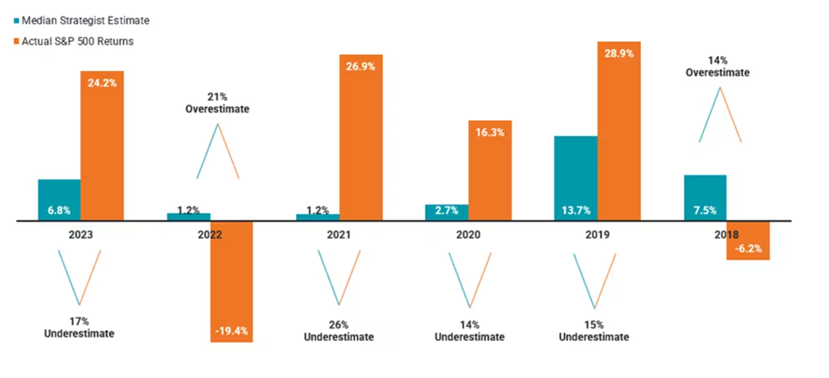
When it comes to forecasting, or attempting to make predictions about what will happen next, we often seen market strategists underestimating or overestimating where markets will finish 12 months on, even with the turmoil of events like war. In the chart below, you’ll see how these under and overestimates in markets are common. That’s why we urge investors to stay invested, trust the process, and stick to their financial plans.
Consensus S&P 500 Index estimates vs. actual returns: 2018 – 2023. Underestimates and overestimates are common. In some years—2022 and 2018—analysts even get the direction wrong.
Source: Morningstar, Inc. “12 Lessons the Market Taught Investors in 2023.” Published January 9, 2024. Indexes shown are unmanaged and not available for direct investment.
Similarly, you may be hearing some chatter around possible recession should the conflict in the Middle East become a long, protracted war. It’s worth noting that recessions are difficult to predict ahead of time, and again, speculation doesn’t necessarily mean a recession is imminent. Consulting firm Fathom Consulting found that of the 469 recessions in 194 countries between 1988 and 2019, the International Monetary Fund had predicted only four by the spring of the preceding year.
Source: Bloomberg, Fathom Consulting, and IMF. Data as of February 23, 2024. “Recession” defined as an annual contraction in real GDP. IMF Working Paper, “How Well Do Economists Predict Recessions?,” Bloomberg, “Economists Lower Recession Forecasts to 40% on US Job Growth Expectations.”
With that in mind, it’s important to remember the fundamentals of successful investing, which is to understand the difference between price and value, and to look to buy quality assets that are worth more than their price at the time of buying. This is what Morningstar are doing across multiple asset classes and markets, looking for opportunities and potential risks. And it’s not just set and forget, as they reassess these decisions every month.
With a well-diversified portfolio of assets that have been purchased at the ‘right’ price with a long-term view, we believe your investments are well positioned to withstand turbulence. Of course, if you have any questions at all, please do reach out to set up a chat.
Receive investment insights straight to your inbox:
By clicking subscribe, you agree to receiving editorial, events, product update and marketing emails from Morningstar and its related parties, until such time that you choose to unsubscribe or update your preferences via the link in the footer of our emails. You also agree to the Morningstar’s Terms, Privacy Policy and Financial Services Guide (AU).