Adviser-to-client template: Why long-term investors stay the course despite headline noise
For financial advisers to use with clients.
This document is intended to support your service proposition to clients. It is produced by our investment writers with a deliberately light tone and structure. However, these are guidance paragraphs only. It is not guaranteed to meet the expectations of regulators or your internal compliance requirements. If you wish to remove or amend any wording, you are free to do so. However, please bear in mind that you are ultimately responsible for the accuracy and relevance of your communications to clients.
Dear Client,
Global events have a way of capturing investors’ attention, particularly when they dominate news headlines and trigger sharp market movements. June was a good example. A fragile ceasefire in the Middle East, along with hopes of a broader peace agreement, helped drive oil prices around 20% lower during the month. Lower oil prices are generally viewed as positive for economic growth and corporate profitability, and share markets responded favourably.
However, as investors, it’s important to separate what feels significant in the moment from what is likely to matter over the long run.
While geopolitical developments can influence markets in the short term, they are often just one chapter in a much longer investment story. The reality is that the situation in the Middle East remains uncertain, and there is every chance that further setbacks or tensions could lead to renewed market volatility in the months ahead.
For many investors, these periods of uncertainty can be uncomfortable. When markets fluctuate sharply, it’s natural to wonder whether action is required. Yet history consistently shows that short-term volatility is a normal feature of investing, not a sign that something has gone wrong.
In fact, research by Nobel Prize-winning economist Richard Thaler, and replicated by the behavioural science team at Morningstar, highlights just how different markets can look depending on the timeframe you choose. If, for example, you check the value of an investment in the S&P500 every day, there is roughly a 46% chance that the market will be lower than the day before. In other words, daily market movements are close to a coin toss.
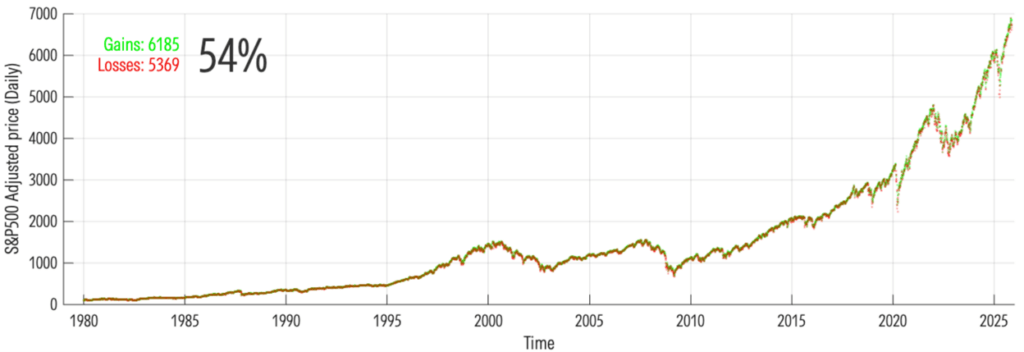
If you extend your observation period to one year, the likelihood of experiencing a negative return fall to around 26%.
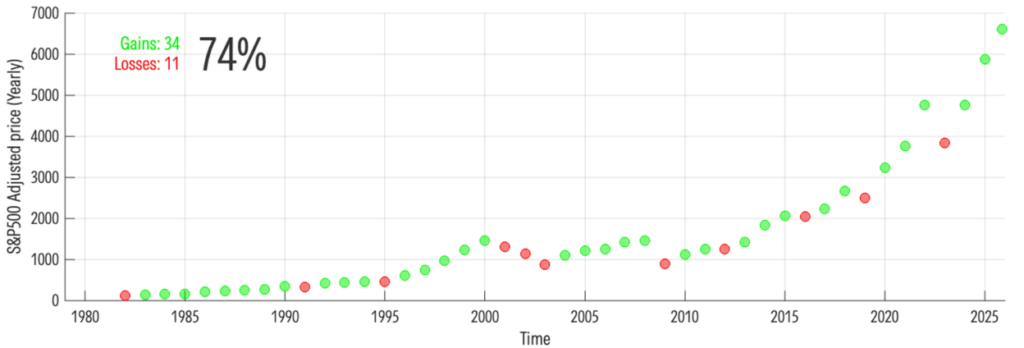
This helps explain why long-term investors are often better served by focusing on their goals rather than daily market movements.
A useful analogy is planting a tree. If you dig it up every few days to check how the roots are developing, you’ll only interrupt its growth. The tree needs time, patience and the right conditions to flourish. Investing works much the same way. While there will inevitably be storms along the way, long-term growth is typically achieved by staying invested and allowing compounding returns to do their work over time.
The headlines will continue to change. Markets will rise and fall. Unexpected events will occur. But for investors with a well-considered plan, these short-term developments should be viewed in the context of a much bigger picture.
So, what’s the key takeaway? Successful investing is rarely about predicting the next headline or market move. It is about maintaining perspective, remaining disciplined during periods of uncertainty, and giving your investments the time they need to achieve their long-term potential.
Signoff
Important Information
As noted previously, this document is intended to support your service proposition to clients and the commentary does not constitute investment, legal, tax or other advice and is supplied for information purposes only. Past performance is not a guide to future returns. The value of investments may go down as well as up and an investor may not get back the amount invested. The information, data, analyses, and opinions presented herein are provided as of the date written and are subject to change without notice. Every effort has been made to ensure the accuracy of the information provided, but Morningstar makes no warranty, express or implied regarding such information. Except as otherwise required by law, Morningstar shall not be responsible for any trading decisions, damages or losses resulting from, or related to, the information, data, analyses or opinions or their use