This document is intended to support your service proposition to clients. It is produced by our investment writers with a deliberately light tone and structure. However, these are guidance paragraphs only. It is not guaranteed to meet the expectations of regulators or your internal compliance requirements. If you wish to remove or amend any wording, you are free to do so. However, please bear in mind that you are ultimately responsible for the accuracy and relevance of your communications to clients.
Dear Client,
Geopolitical tensions are continuing to dominate headlines, and the impacts are being felt here in Australia. With the numbers at the bowser climbing, we know you may be concerned about the ongoing impact of the conflict both on your investments and in a broader context. Though recent news of a ceasefire between the US, Israel, and Iran has headlines buzzing, the details can be overwhelming. But, despite the noise, we and our investment manager, Morningstar, are concentrating on the things we can control and taking a long-term approach that’s been designed to withstand volatility.
What we know so far
It’s a fast-moving situation, so let’s stick to the essentials. The US, Israel, and Iran have agreed to a preliminary 14-day pause in hostile actions to allow for broader peace talks. This includes reopening the Strait of Hormuz, a significant shipping channel, though not without conditions. While progress has been made, multiple strikes were still reported across the Gulf after the agreement was meant to take effect.
What this means for portfolios
Morningstar’s long-term investment approach has been tried-and-tested through all types of volatility, including the COVID-19 pandemic, ‘Tariff Day’ turbulence, and even the Global Financial Crisis. By choosing a well-diversified group of assets, rigorously evaluating risk, and paying close attention to the price paid for investments, the Morningstar investment team focus on building robust portfolios that are positioned to weather rapidly changing conditions.
What you should do
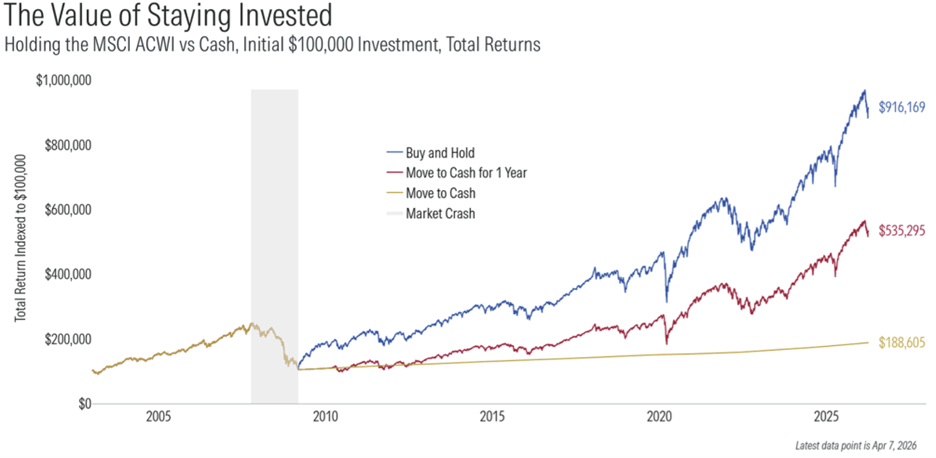
As ever, a core principle of successful investing is to stay invested. The below chart, where the grey column highlights the GFC years, shows the difference between moving to cash, moving to cash for one year, and simply holding and staying invested. The blue line – staying invested – is the clear leader.
Source: Clearnomics, MSCI, Federal Reserve. Past performance is no guarantee of future results. This is for illustrative purposes only and not indicative of any investment.
As you can see, investors who stayed invested not only endured the volatility, but continued to experience an upward trend of returns, even considering additional periods of market drops.
We’re always available to talk
Of course, it can be tricky to withstand this in the moment, so please feel free to reach out for a conversation at any time. If you have questions about your portfolio or your financial plan, I’m happy to help.
Receive investment insights straight to your inbox:
By clicking subscribe, you agree to receiving editorial, events, product update and marketing emails from Morningstar and its related parties, until such time that you choose to unsubscribe or update your preferences via the link in the footer of our emails. You also agree to the Morningstar’s Terms, Privacy Policy and Financial Services Guide (AU).