Read if your clients are asking, are we seeing indicators of a market downturn? (est read time: 5 mins)
With regular news stories about the US, China and Brexit, you’ll have clients worrying about their investment portfolios. Questions we’ve been hearing include when will the market peak? Are you seeing indicators of a downturn? And how are your portfolios positioned? We’re here to enable you to answer theses questions fully and to reassure your clients their portfolios are positioned appropriately for the current investment conditions.
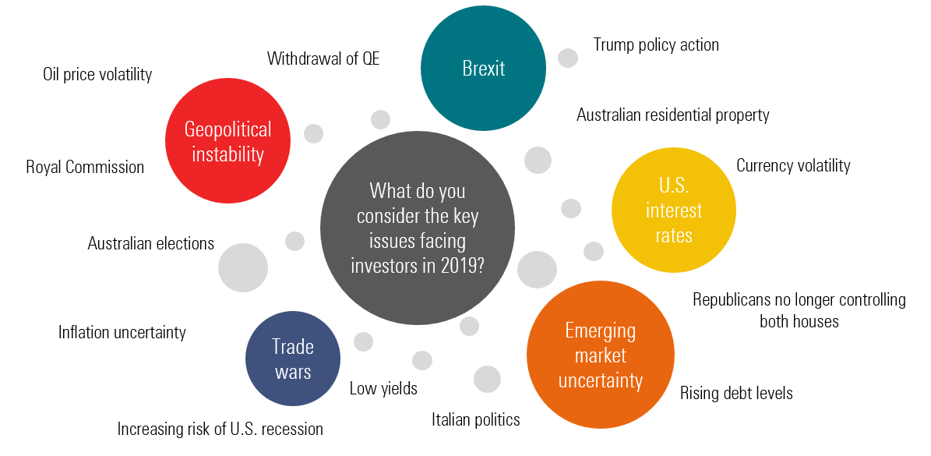
This image shows what kind of things your clients might have on their minds:
The thing with this list (and it’s by no means exhaustive) is that there are a lot of very important issues still to be resolved…. But their outcomes cannot be predicted with any great certainty. The way we approach these events is through the lens of our valuation analysis – are we getting a good deal in markets or not? In that respect, share and bond markets are generally overvalued, meaning there is the heightened risk of loss.
With this in mind, the portfolios were defensively positioned leading into the period of volatility at the end of last year. As such, they didn’t fall as much as peers, which is what we would expect in overvalued markets. Further, we took the opportunity to add small amounts of share exposure to your clients portfolios given the slightly better valuations the volatility produced. This served the portfolios well.
Fast forward to now and investment markets have had a bounce since Christmas and are back to valuations we’d consider over valued. As such, the portfolios remain defensively positioned.
So back to your clients original questions around how their investment portfolios are positioned, the portfolios are positioned to withstand future volatility, whilst being poised to take advantage of investment opportunities as they arise. It’s hard of course to identify a catalyst and timing for weakness but our valuation analysis suggests that we should be cautiously positioned now, with the risk of loss elevated. Indeed, as it stands, all portfolios are holding fewer growth assets and bonds as well as higher levels of cash than they otherwise might under “normal” conditions (i.e. both equities AND bonds look generally expensive to us). This is not to say we can’t get more defensive if we need to (i.e. valuations become even more unattractive) – we still have many levers to pull to help limit losses in overvalued markets.
Receive investment insights straight to your inbox:
By clicking subscribe, you agree to receiving editorial, events, product update and marketing emails from Morningstar and its related parties, until such time that you choose to unsubscribe or update your preferences via the link in the footer of our emails. You also agree to the Morningstar’s Terms, Privacy Policy and Financial Services Guide (AU).