The Threat of a Recession Has Subsided. Are Your Clients Prepared for the Next One?
By Danielle Labotka, Behavioural Scientist
There’s a saying in theater: “Bad dress rehearsal, good opening night.”
In many ways, we just had a dress rehearsal for a recession.
Though investor sentiment has since turned around, new research from Morningstar found that investors came into the year expecting a recession and, in many cases, were already preparing for it—and not always in a smart way.
But now that the imminent threat of a recession has subsided, it’s a good chance for advisers to learn from what investors did when they were worried. By getting familiar with what these decisions looked like, advisers can work better with clients to achieve their investing goals amid inevitable market downturns. After all, opening night is only better than the dress rehearsal if the actors have learned from it.
The results of the study suggest there are two major things advisers can do now: 1) play catch-up and 2) get ready to go on the offensive.
Catch Up on Clients’ Financial Actions
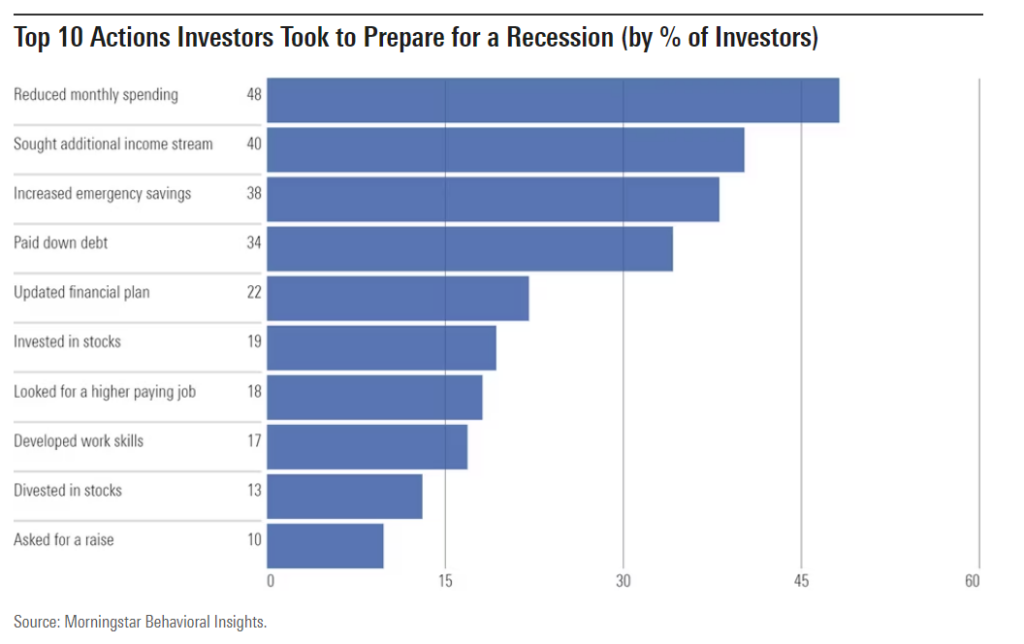
In the face of a recessionary threat, 87% of investors took at least one action to prepare for a recession. For about half of all investors, that included touching their investments.
Since its original publication, this piece may have been edited to reflect the regulatory requirements of regions outside of the country it was originally published in. This document is issued by Morningstar Investment Management Australia Limited (ABN 54 071 808 501, AFS Licence No. 228986) (‘Morningstar’). Morningstar is the Responsible Entity and issuer of interests in the Morningstar investment funds referred to in this report. © Copyright of this document is owned by Morningstar and any related bodies corporate that are involved in the document’s creation. As such the document, or any part of it, should not be copied, reproduced, scanned or embodied in any other document or distributed to another party without the prior written consent of Morningstar. The information provided is for general use only. In compiling this document, Morningstar has relied on information and data supplied by third parties including information providers (such as Standard and Poor’s, MSCI, Barclays, FTSE). Whilst all reasonable care has been taken to ensure the accuracy of information provided, neither Morningstar nor its third parties accept responsibility for any inaccuracy or for investment decisions or any other actions taken by any person on the basis or context of the information included. Past performance is not a reliable indicator of future performance. Morningstar does not guarantee the performance of any investment or the return of capital. Morningstar warns that (a) Morningstar has not considered any individual person’s objectives, financial situation or particular needs, and (b) individuals should seek advice and consider whether the advice is appropriate in light of their goals, objectives and current situation. Refer to our Financial Services Guide (FSG) for more information at morningstarinvestments.com.au/fsg. Before making any decision about whether to invest in a financial product, individuals should obtain and consider the disclosure document. For a copy of the relevant disclosure document, please contact our Adviser Solutions Team on 02 9276 4550.