Bond markets are dominating headlines, which is a rare occurance.
While a relatively unexciting asset class, bonds can offer a solid source of income.
Some bonds also offer diversification benefits. Specifically, government bonds can play a positive role.
Bond yields can hint at recessionary risks, although context and valuations must be considered.
To be effective, we must consider bonds holistically, always thinking about reward for risk.
You might be wondering what all the fuss is about bonds at the moment… Let’s face it, bonds rarely dominate the headlines. Yet, with recession risks rising, many are looking to the bond markets for clues and protection.
In this sense, we should first offer perspective. Fixed-income markets have enjoyed one of the greatest 30- to 40-year bull markets in history. With bond yields falling from highs of over 15% in the early 1980s to lows of around 1% today, the asset class has delivered unprecedented outcomes for cautiously-minded investors on a risk-adjusted basis. In many ways, fixed income has been akin to the world’s greatest defence, with an ability to score goals (deliver returns) and never concede (rarely suffering downside risk).
The challenge is that the next 5, 10 or 30-40 years may not be the same. So, given this dynamic, why do bonds matter and how can they help you? We instil three key pillars of thought below, hopefully highlighting the compelling story of opportunity and risk management.
How Bonds Can Help 1: As a Source of Income
Bond investing is conceptually quite simple. A government or company needs to raise capital, so will issue bonds at a fixed rate of interest. This rate depends on the quality of the company (a higher risk corporate will need to pay higher rates to compensate for risk) and the time horizon they want the money for.
So, as an investor, you can lock in the current rate and—assuming you are willing to hold for the full maturity—will get your money back along with the income along the way.
How Bonds Can Help2: As a Diversifier
One of the great features of holding bonds is that they bring something different to the table, specifically by diversifying equity risk. During episodes of sharemarket panic, bonds tend to be more resilient, offering some offset to equity losses.
To be effective though, it is important to differentiate between government bonds and corporate bonds.Corporate bondreturnscan be correlated with equities, as they tend to share the same underlying cashflow risks, for instance, if a company goes bust, both the stocks and the bonds of that company will fall. On the other hand, government bonds tend to be more protective during periods of market panic for three key reasons: 1) they are considered to have little to no default risk and offer a lot of liquidity, therefore benefitting from a ‘flight to safety’, 2) the rates on offer tend to be tightly linked to the health in the economy, benefiting if interest rates get cut, and 3) they often involve longer holding periods, which increases the sensitivity to changes in interest rates.
It is important to note that many government bond markets are currently offering low yields, which has reduced their ability to provide diversification in the event of equity market weakness. For instance, U.K. government bonds will now give you less than 1.0% over a 10-year period, despite the political turmoil amid Brexit. In this environment, it is important to be selective, and as such, we favour shorter-dated bonds, especially in the U.S, which offer greater value than longer-dated bonds.
How Bonds Can Help3: As a Recession Signal
Headlines throughout 2019 have been dominated by the concept of “yield curve inversion” (where bonds with a longer time to maturity yield less than those with a shorter date) and recession risk. Historically, bond markets have offered a useful signal of recession risk during rare but specific periods. We are now in the midst of one of these periods—at least in the U.S. market—raising concerns about everything from jobs to stock markets.
The real question here is whether bond investors have predictive abilities over the economy or markets. When it comes to managing a portfolio, we only really care about the markets, where the relationship is tenuous at best.
Picking the Right Bonds to Support a Portfolio
At this juncture, it is healthy to remind ourselves of the two key roles lower-risk bonds play in a portfolio: 1) as a source of return, and 2) to diversify equity risk. Like any asset, the risk and reward for bonds evolves over time, subject to changes in levers such as rates, quality, the time to maturity and liquidity; to name a few. It is therefore important to keep monitoring these levers. At present, we find a troubling mix of lower yields with higher risk.
If we use a soccer analogy, we know that a well-constructed team requires a mix of strikers, midfielders, and defenders. For government bonds, they may not offer much by way of attack (poor long-term return prospects due to the low rates on offer) but have had an ability to hold up defensively when called upon (especially if stocks sell off). The key is to consider the opportunity set holistically and not rely on any one player.
Balancing this, we tend to find our portfolios have a greater weight towards those assets we believe can best withstand the headwinds. These includes shorter dated bonds; bonds with higher rates or yields (greater income); and higher credit quality (downside protection). Otherwise, we prefer to hold healthy levels of cash, offering ammunition should conditions worsen. As ever, risk and return must always be weighed in unison.
Real-estate investment trusts, or REITs for short, have become an increasingly popular vehicle for real estate ownership in many global financial markets. The REIT sector has grown significantly over the last two decades; both in terms of REITs being introduced in new countries, as well as the increase in the size of the sector across existing jurisdictions. In fact, it’s currently estimated that the global REIT market exceeds US$1.2 trillion. The bulk of these assets remain in the U.S. (more than half of the global REIT market). Other prominent markets include Europe (both the Euro area and U.K.), Hong Kong, Australia, Singapore, Japan and smaller markets such as South Africa. Like many asset classes, REITs find themselves at an important juncture in 2019, with the potential for rising interest rates over the medium to long-term threatening the strong returns achieved from this asset class over the last decade. Of course, any short-term cuts to interest rates could likely have the opposite effect. This comes at a time of stretched valuations, adding further risk to an already complex setting.
Is Listed Property a Defensive Asset?
Historically, this sector has been considered to offer defensive characteristics. In part this is due to the stability of the underlying cashflows and in part due to its relationship with bond markets – often considered a “bond proxy”. However, we are of the opinion that valuations need to come down to justify such an assessment going forward. Let’s not forget that real estate values are high in most developed markets. This has made it more difficult for REITs in those regions to locate and execute profitable acquisitions.
The Downside to Listed Property
During the Global Financial Crisis (GFC) many of the largest REITs in the U.K. and Australia had to undertake “rescue” rights issues due to high gearing levels involved in the sector. This was exacerbated by the significant devaluation of properties that occurred. Given a similar setting today—with stretched property valuations and a continued reliance on debt—it should not be controversial to say that leverage concerns could resurface if asset valuations were to fall significantly from here. To provide further context, we can scan the globe. The best performing REIT market over the 12-month period to 28 February 2019 has been Hong Kong, mainly driven by investors favouring domestic assets which are expected to be less impacted by trade wars between the U.S. and China (as well as the market expectation that the U.S. Federal Reserve will delay raising interest rates). To the contrary, South African REITs were among the worst performing region, although this is perhaps nuanced. South African REITs experienced a large sell-off in early 2018, due to reports from Viceroy around certain valuation principles followed by listed property providers.
Underlying this, prices have already come down considerably in several areas, such as retail REITs, while other areas like industrial assets have propped up the performance numbers. The question that needs to be asked is why the prices have deviated so significantly and what specific risks investors are already pricing in, versus those that they can’t yet see. For example, the U.K. faces an interesting period, in part due to Brexit fears that are likely priced in, although we’d caution that risks remain.
The Risks Faced by the Listed Property Market
Rising interest rates over the medium to long-term, especially in the U.S. market.
Slowing economic growth or an inflation shock (particularly in the U.S. or China).
Already stretched valuations (especially following the large jump in January 2019).
Retail pressure, especially in developed markets. For example, the trend in the U.S., Australia and U.K. is to have destination malls—with more food and service.
A Low Conviction in a Popular Asset Class
Over the next decade, REITs likely face two significant headwinds:
1) a predisposition of stretched valuations and reasonably high debt, and
2) a vulnerable growth rate that could easily move back towards trend and result in pockets of divergence.
Market darlings at the moment include industrial REITs, however investors should be aware that it is currently a relatively crowded trade. When considering industrial REITs, investors with unique and well positioned assets, such as those near ports, are less susceptible to supply competition. Put together, the large price increases over the past five years may unwind, posing a potential danger to real estate investment. In addition, we’d add that new construction has been moderate (approximately in line with demand), keeping vacancy rates stable combined with rising rental charges. That said, any increase in interest rates, which could be reasonably expected over a 10+ year period, would pose a challenge to REITs pricing going forward.
Any Pockets of Opportunity?
So, where are we currently seeing opportunity? Value-orientated investors may find opportunities amongst retail REITs and/or South African REITs, however there are risks that need to be balanced with the potential reward.
Taking these factors into account REITs can be a diversifying asset in a multi-asset portfolio but are of the opinion that high valuations would lead to adopting a lower weight at the present time.
The Case for Holding Japanese Equities (est read time: 5 mins)
Bryce Anderson , Portfolio Manager, Asia Pacific Clémence Dachicourt, Portfolio Manager, Europe, Middle-East & Africa
Japan has endured
a remarkable period of economic stagnation, but the future looks brighter.
A legacy
of poor corporate governance hampered Japanese equities, although this is
improving. As a result, dividends and buybacks continue to improve from a very
low base.
The fundamentals are reasonably sound. The deleveraging cycle appears to
be halting, while corporate profitability in Japan is at 20-plus year highs.
Amid the structural reforms, if the banks can find a way to lend more, we see
opportunities for upside.
The valuations are still cheap, especially among Japanese financials. Taken
together, we like Japanese equities from current levels and assign a “Medium”
conviction.
The lost decades in Japan have become one of the
defining investment stories of our time. From its 1989 highs, the country endured
a sustained period of weak economic growth with intermittent recessions and
periods of deflation that resulted in stagnant economic growth. Asset price
deflation accompanied these economic woes, and both equities and residential
property remain below their 1989 highs.
This has created a fascinating situation, with an extended period of stress and many false starts. In an attempt to end the ongoing trauma, promote growth and counteract the deleveraging in the private sector, the government of Japan increased leverage significantly to become one of the world’s most indebted countries (with a debt-to-GDP ratio at over 200%). Only recently has corporate leverage finally returned, perhaps enabling the government to ease its own debt issuance.
The question is whether Japan is ready to turn the corner—both economically and in the markets. While the relationship between the two is often tenuous, Japanese equities remain relatively unloved and could be an attractive long-term position as well as offering diversification benefits. This is especially true if Japanese companies can sustain their profitability growth, which has turned the corner after a few poor decades.
To assess the potential for improved profitability, one must acknowledge what went wrong and why. One of the most-cited problems was weak corporate governance, which resulted in poor dividend policies, obscure compensation schemes, a lack of appropriate risk-taking, a very low percentage of independent directors and high cross-shareholdings, making merger and acquisition activity problematic. Japanese companies also failed to target appropriate profitability metrics, leading to high cash holdings and a general perception that they don’t always act in the best interests of shareholders. As such, investors have priced in a valuation discount relative to global peers.
So, what is going on and could we expect a change?
With so many underlying issues, investors have been
yearning for a catalyst. Regarding profitability, in 2012, along came Abenomics
and the so-called “Third Arrow”, as Prime Minister Shinzo Abe tried to
stimulate economic growth and address some of the profitability issues that
have plagued Japanese companies. As a part of this response, Japan’s Corporate
Governance Code—aimed at reversing poor corporate governance practices—came
into effect on June 1, 2015.
Sceptics were quick to
question whether the government could influence the fundamental structure that
had held back corporate Japan for so long. For example, in
Japan very high corporate cash holdings were associated with a low percentage
of independent directors, but it wasn’t clear whether government regulation
would meaningfully shift that cash into shareholders’ pockets.
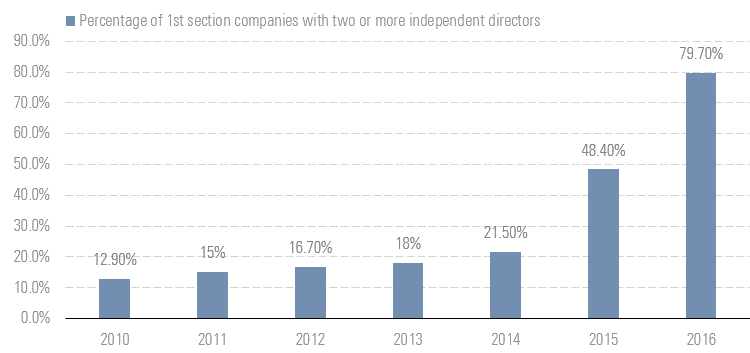
Now several years into Abenomics, we’re able to see some clear positive developments. One of the most encouraging has been profitability targeting by corporate management, which has increased rather dramatically.
As intended, independent directorship also increased significantly, with the Corporate Governance Code acting as an effective method for change. This was undoubtedly encouraging, but it is worthwhile remembering that it will only be helpful if it drives outcomes such as increased payouts to shareholders.
Chart 1 The changing structure of company management is also encouraging
Source: JPX Tokyo Stock Exchange
In respect to payouts, dividends in absolute terms have increased across the board and payout ratios have grown significantly. In addition, buybacks (which only became a legal practice in 1994) have grown in popularity, as the number of companies initiating their first buyback program continues to increase. We believe that these developments are likely to be structural and profoundly important for investors, although wouldn’t be surprised if it is slow-moving progress.
Are Japanese financials the key?
The last piece of the puzzle is valuations, which
continue to trade at a discount to global peers. Much of this is driven by the
large caps, especially financials, which is a segment we find appealing. This
sector has been plagued by some of the aforementioned problems in Japan—the
deleveraging and deflation following excesses of the past—which has left the
sector with a lot of upside.
We note that financials are largely a function of the
economy, with a reasonable portion of its profitability attributable to lending
(either via credit growth or net interest margins). Fundamentally, this may
remain a constraint to price growth, although could offer upside if corporate deleveraging
reverses.
However, quite a large part of the financials opportunity
is sentiment. Valuation multiples among Japanese financials are some of the
lowest we have seen and appear to be factoring in bleak times well into the
future. Whilst it is not likely Japan is going to grow rapidly, we just don’t
think the market appreciates many of the structural changes underfoot.
Of course, there are other influences which must be
considered too. For starters, currency
trends have played their part, with the Japanese yen enduring volatility. Industry concentration also remains low across the Japanese corporate
landscape and whilst some evidence of consolidation is apparent in pockets, the
level of M&A is not widespread.
Yet, regardless of how one views it, there are likely two
key pillars that make Japanese financials a potentially enticing opportunity:
The fundamentals are reasonably sound. The deleveraging cycle appears to
be halting, while corporate profitability in Japan is at 20-plus year highs.
Amid the structural reforms, if the banks can find a way to lend more, we see
opportunities for upside.
The valuations are still cheap. If investors realise the demons of the
past are behind them, we may see a re-rating of these companies which would
offer upside.
Assessing our conviction
With positive developments evident in the Japanese
corporate sector, we must consider how much is priced in and whether holding
Japanese equities is complementary in a portfolio context. To do so, we employ
our four pillars of conviction, which is our way of considering the holistic
opportunity under a long-term, valuation-driven framework. In this regard, we
want to address: 1) the absolute expected return, 2) the relative expected return,
3) fundamental risk, and 4) contrarian indicators.
Looking at these together, we find that Japanese
equities look reasonably attractive – with valuations that look encouraging compared
to other key markets. The financials sector also lines up well with other
opportunities such as European telecommunications, providing reasonable
forward-looking prospects and a profile that offers diversification benefits to
investors. From a fundamental risk perspective, there is still some volatility
in the cash flows and some concerns that profitability is at a cyclical high, tempering
our enthusiasm somewhat.
Overall, we view Japanese equities as a “Medium” conviction opportunity, reflecting developments that continue to be both captivating and compelling.
In this Q&A on investment markets, our in-house investment professionals answer your most pressing questions.
Key Takeaways
We’re entering an important period, with heightened volatility expected. This is not a time to be scared, but rather, to focus on long-term opportunities.
The recent market rise is a peculiar one, with central banks influencing the direction. We see risks to such a move, although welcome the positive returns for our investors.
Emerging markets have been impressive lately, which many wouldn’t have expected.
U.S. profits have been strong, perhaps too strong, which we’d expect to moderate over the long term.
Generating income in this environment is complex, especially when accounting for credit quality and concentration risks.
How are you positioned given all the risks coming up (Brexit, etc.)?
As long-term investors, we remain broadly defensive and aware of the risks in many key markets. That said, we’re also ready to act quickly where should opportunities for long-term gain arise.
Based on current pricing, we see greater opportunities for equity exposure in areas such as Europe (including the U.K., on valuation grounds) and emerging markets. For fixed income, we have a bias towards higher-quality issuers including U.S. government bonds, while still holding healthy cash levels.
Put together, we see scope for further market unrest but remain confident in our positioning if this occurs. We don’t believe this is a time to be scared, but rather, to seek out opportunities for long-term gains.
Why are markets jumping now? Does this make sense to you? Surely, the central banks are only changing direction due to the risk of a recession.
First, let’s set the scene. Since Christmas, we’ve seen a broad-based market rally, due primarily to the change from a tightening bias to a neutral stance by the Federal Reserve. This is considered stimulatory, at least in a relative sense, as many seemed worried about growing recession risk on the horizon.
In this way, it does seem peculiar that the value of a business grows because the economy is souring. However, it depends on the company or industry in question. Those with high debt could benefit from the extension of lower interest rates, for example. But to be sure, trying to understand markets in the short term is a bit like reading tea leaves: plausibility too often passes for proof.
We tend to view the investment landscape over a 10-year-plus horizon, where we see no need to change our stance. All risk assets have gained—not just U.S. equities—and fixed-income markets have rallied too. We welcome the positive returns, however remain cautiously positioned given the heightened risks. To us, the risks aren’t just an economic recession—there are valuation and leverage risks to be managed as well.
Why have emerging-markets stocks been so strong lately? In a sell-off, many would have assumed they would fall harder than the rest.
Perspective is important here too, as emerging-markets equities already took a hit in early-mid 2018 on concerns over the impact from a strong dollar, weaker Chinese growth, and the impact from the trade war. With this bad news mostly being priced in, it is in some ways no surprise they offered greater relative protection in the late-2018 equity sell-off. On most measures, emerging-markets valuations improved markedly overall, but we’d caveat this by saying there are great country differences as the block is very heterogenous. For example, we’re seeing greater value in countries like South Korea and Taiwan, both of which have been suffering from their more cyclical exposure to a weaker semiconductor sector, linked once again to recession concerns. We also find more value in idiosyncratic markets like Russia and Turkey, although they are not without clear risks and hence the range of outcomes in both markets is wide. The most unattractive parts remain Latin American, Southeast Asian, and Indian equities, largely on valuation grounds, in our view.
Is it reasonable to expect U.S. companies to grow profits faster than other markets?
Companies in the U.S. have certainly performed well, with strong revenue and earnings growth over the past decade. These same companies also have an impressive ability to innovate and have a strong presence in growing parts of the global economy. That said, we don’t think the recent earnings growth is likely to be sustainable. In the very long run, our analysis shows that companies in aggregate tend to grow earnings at around the same rate as the nominal economy, give or take. So, it would seem reasonable that U.S. companies will see earnings moderate. How this transpires relative to other markets is difficult to judge, as is the way one can execute on such views. One of the biggest execution challenges is understanding what is priced in. On all valuation measures (e.g., price/book, price/earnings, price/sales), the U.S. is expensive, often by a record margin relative to other markets. This means that investors are already expecting stronger earnings growth in the U.S., which we don’t think is a compelling thesis.
Read if your clients are asking, are we seeing indicators of a market downturn? (est read time: 5 mins)
With regular news stories about the US, China and Brexit, you’ll have clients worrying about their investment portfolios. Questions we’ve been hearing include when will the market peak? Are you seeing indicators of a downturn? And how are your portfolios positioned? We’re here to enable you to answer theses questions fully and to reassure your clients their portfolios are positioned appropriately for the current investment conditions.
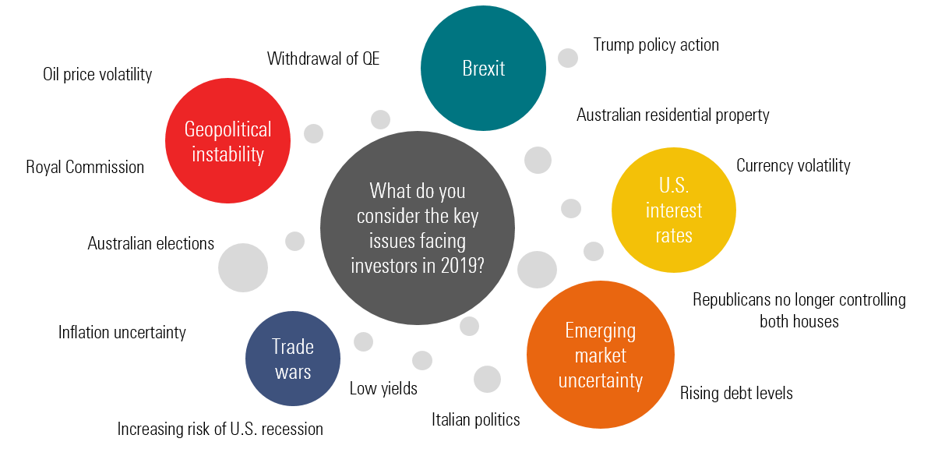
This image shows what kind of things your clients might have on their minds:
The thing with this list (and it’s by no means exhaustive) is that there are a lot of very important issues still to be resolved…. But their outcomes cannot be predicted with any great certainty. The way we approach these events is through the lens of our valuation analysis – are we getting a good deal in markets or not? In that respect, share and bond markets are generally overvalued, meaning there is the heightened risk of loss.
With this in mind, the portfolios were defensively positioned leading into the period of volatility at the end of last year. As such, they didn’t fall as much as peers, which is what we would expect in overvalued markets. Further, we took the opportunity to add small amounts of share exposure to your clients portfolios given the slightly better valuations the volatility produced. This served the portfolios well.
Fast forward to now and investment markets have had a bounce since Christmas and are back to valuations we’d consider over valued. As such, the portfolios remain defensively positioned.
So back to your clients original questions around how their investment portfolios are positioned, the portfolios are positioned to withstand future volatility, whilst being poised to take advantage of investment opportunities as they arise. It’s hard of course to identify a catalyst and timing for weakness but our valuation analysis suggests that we should be cautiously positioned now, with the risk of loss elevated. Indeed, as it stands, all portfolios are holding fewer growth assets and bonds as well as higher levels of cash than they otherwise might under “normal” conditions (i.e. both equities AND bonds look generally expensive to us). This is not to say we can’t get more defensive if we need to (i.e. valuations become even more unattractive) – we still have many levers to pull to help limit losses in overvalued markets.
The Four Big Talking Points into 2019 (est read time: 4 mins)
Mark Preskett, Portfolio Manager Europe, Middle-East & Africa
Brad Bugg, Head of Multi-Asset Portfolio Management, Asia-Pacific
Key Takeaways
Four of the big talking points dominating headlines are trade wars, Brexit, rising interest rates and most recently, the risk of a global recession
The deterioration in trade negotiations saw declines across large parts of the emerging markets and Europe, which we believe may offer opportunity
Brexit carries a lot of uncertainty, although much of the downside appears priced in. We like U.K. multinational equities, but remain cautious towards U.K. domestic equities and bonds
Interest rates in the U.S. rose through most of 2018, having a negative impact on bond markets. This could make them more attractive, particularly if trouble lies ahead
A slowing economic backdrop could impact corporate earnings and profit margins, which we believe are too high and likely to revert. In fact, we are cautious of the U.S. market more broadly for this reason.
2018 proved to be a challenging year for investors. We’re still grappling with trade tensions, political instability, rising interest rates, and a mature business cycle. Yet, perhaps of more importance, investors are now also questioning the durability of returns and recognising that markets won’t always go up.
Under such a dynamic, the investment landscape is offering both opportunities and dangers. With that said, we take the opportunity to look at four of the big talking points and how we are positioned at the start of 2019.
Trade Wars
Investors punished emerging markets in 2018, but we don’t think the sell-off has been justified by fundamentals. We still like emerging markets, both stocks and bonds, as we believe the downturn in sentiment towards this investment area has been driven largely by fear. A key focal point has been the trade-war rhetoric, with emerging markets being put under significant pressure as capital outflows persisted. This is true both at an asset level and at a currency level, although the fundamental thesis and economic progress is largely unchanged. Perhaps most prominently, we saw the execution of trade tariffs, which severely dented sentiment towards some of the emerging markets and supported the US dollar. Amid the concerns, we also saw further weakness in Europe as export-driven markets like Germany sold off.
Positioning: We believe a healthy allocation to emerging markets and Europe is warranted. Both regions offer reasonably attractive reward-for-risk, especially compared to the U.S. market.
Brexit
U.K. investors are being forced to contemplate some incredibly difficult decisions. With Brexit a major fundamental risk to the economic outlook, nervousness is taking hold. The first thing to acknowledge is that the UK economy is not the UK equity market. Approximately 70% of the FTSE 100’s earnings come from overseas, and one must appreciate that the fundamentals of corporate Britain have been reasonably resilient. Given the unprecedented nature of Brexit, many investors struggle to comprehend how to price it into asset values. The fund flows appear to show that managed fund and ETF investors are erring on the side of caution and investing elsewhere, which is no doubt influenced by the noise of daily politics.
Positioning: While the economic relationship with the U.K.’s largest trading partner will remain unclear for some time, we are pragmatically and patiently growing more positive on multinational UK equities. We are more cautious towards U.K. domestic stocks and don’t see much appeal in U.K. fixed income. We also like the pound sterling at current levels, although acknowledge that further downside risk is present.
Rising global interest rates
For some time now, investors have had to grapple with the implications of increasing borrowing rates. This theme continued through 2018, with most central banks (excluding Japan) clearly indicating they are either unwinding, or planning to unwind, the monetary stimulus that has persisted for the best part of a decade.
This has muted returns from some fixed income markets, especially global government bonds with longer duration, whilst inflation-protected bonds continue to be shaped by a rollercoaster of changing inflation expectations. Global corporate bonds have also had to deal with a rise in spreads, especially in the US.
We have reason to believe that bond yields will trend higher and revert towards more normal levels, but we can’t predict (nor can anyone) the path or timing. But the larger issue may be a behavioral one, as it often is—it’s easy to fear rising rates and rashly trade out of bonds. This would be a mistake in our opinion, as we can’t know the future, and higher-rated bonds continue to provide diversification to equity risk. The path to higher rates is anything but certain, and bonds can play an important role in most market environments, particularly if trouble lies ahead.
Positioning: As yields on global bonds rise to more sustainable levels, we’re gradually adding bond exposure across our portfolios. However, we’ve also taken steps to mitigate the potential losses caused by rising rates. This includes shorter-duration positioning and a preference for higher-quality issuance.
Global Recession Risk
From our fundamental work, it is clear that corporate profits have been trading at cyclical highs for some time, especially in the U.S. market. At the same time, a range of economic indicators—from manufacturing surveys, car sales and house prices—suggest economic growth is moderating. This combined with stiffer regulations and some high-profile corporate failures has led investors to question the lofty expectations of large swathes of the equity market.
We’re always careful of the “this time is different” argument, so we looked carefully at the factors that may explain higher profitability at U.S. firms. We found some cause for profit margins to remain higher than normal, but over time we expect these margins to eventually retreat.
Positioning: We think U.S. stocks are overpriced and believe selling overpriced assets is a good discipline. We maintain our cautious stance towards the U.S. market, with the asset class now offering negligible expected returns after inflation, on our valuation analysis.
Summary
From a performance perspective, markets continue to experience mixed conditions that carry an undercurrent of nervousness. This creates an interesting landscape for us to add long-term value.
Share with your clients: What Are You Benchmarking in 2019? (est read time: 5 mins)
Dan Kemp, Chief Investment Officer, Europe, Middle-East & Africa
Eugene Visagie, Portfolio Specialist, South Africa
Key Takeaways
Benchmarking your financial progress is a key tool for success, but it’s often done referencing the
wrong things and over the wrong timeframe
Benchmarking is often done as a rear-vision exercise. Decision-making should be forward-looking
At its extreme, incorrect benchmarking can leave investors prone to “chasing winners”, which may
hinder their ability to meet their financial goals
Benchmarking against peers or an index is a concept used to help define whether an investment
proposition is delivering value. It is well intentioned; however, we should acknowledge the
shortcomings
Investors have unique goals, so any benchmarking should ideally align with those goals.
When you invest, it’s important to remember that you’re making a short-term sacrifice for a longer-term gain. In most instances, the objective is financial prosperity, security, or the attainment of a goal, which are all typically longer-term in nature. This may sound obvious, but it highlights one of the biggest issues we find around this time of year. Primarily, investors often spend their time reviewing performance against a designated benchmark, but this can result in a biased comparison, where the wrong things are compared to each other over the
wrong timeframe. We’ll elaborate on this, but want to ask you throughout: What will you be benchmarking in 2019?
Measuring Success
Imagine a scenario in which you achieved 5% over 2018. Was this a success? Perhaps. How about if we added that the return was 4% less than the previous year, 3% above the peer-average, 2% above inflation and 1% lower than your desired level of return. Was this now a success? Maybe…
How about now adding the knowledge that one asset was attributable for your total return. You held other assets, but these netted off and went sideways in aggregate. You also took more risk than you’d have liked, which made you anxious at certain periods of the year. What about now? Hmm…
This example hopefully helps illustrate the complexity of appropriate benchmarking. There are many moving parts, some of which you can control—risk taken, assets held, timeframe considered—and many others you can’t.
As individuals, it’s important that we can each measure our own success in a way that is appropriate to the circumstance. Ideally, this will include a robust and repeatable framework, which may or may not use benchmarking tools. The list of tools at your disposal is theoretically endless, although must be appropriate.
What Tools Are Available?
As an industry, most investments options are benchmarked against one of the following:
Peer relative. Often done in quartiles, where portfolios are ranked against comparable managed portfolios on a scale of 1 to 4
Index relative. Where a portfolio is measured against a passive benchmark net of fees
Absolute return. Often seeks to return a consistent positive level over time, regardless of inflation, interest rates, and other variables
Real return. Seeks to deliver a level of return over inflation, growing the purchasing power of the portfolio over a defined period.
Each of these methods has advantages and disadvantages, with the most applicable likely to depend on what you are trying to achieve. For example, many asset managers benchmark against relative outcomes—from index-relative (fuelling the active versus passive debate) to peer-group comparisons— all designed to sort the winners from the losers.
This relative benchmarking is well-intentioned and can be useful if considered over longer periods. However, it can sometimes misalign to the reason we invest. Perhaps most prominently, it sometimes leaves investors inclined to favour the “best” performers and yearn to be part of this echelon. Investors similarly look down on the “worst” performers and sell in frustration.
This shouldn’t be underestimated. If an investor feels that they are underperforming, they will be psychologically prone to act. At its extreme, this impulse can lead investors down a garden path where they expect to be top-quartile performers at all stages of their journey – regardless of how that links to their desired destination.
What Is the Ideal Benchmark?
The best benchmark is one that is forward-looking and aligned to your financial goals. In a perfect world, every investor deserves their own framework to benchmark success, with transparency, measurement, and perspective all to be embraced. The challenge, of course, is that a forward-looking assessment is incredibly difficult to quantify, and there is no such thing as the “one-size-fits-all” approach. Benchmarking tools—such as those listed above—are powerful, but you cannot unshackle the backward-looking nature of them. What matters to an investor is whether their investment might be expected to help them achieve longer-term gains into the future. This mismatch requires care and highlights an important point around process versus outcome.
Specifically, it’s entirely possible to have a strong process (or a good decision) with a bad outcome, just as it is possible to have a poor process with a strong outcome. However, more often than not, a strong process will prevail and result in strong outcomes and vice versa. This is a key reason why we stress that people make comparisons over a longer time horizon — it allows the strength of the process (or the
combination of many decisions) to unveil itself.
To bring this to life, we can suggest a checklist to reinforce the link between goals and your investments. We split this into two distinct categories, where the idea is to first align your framework to your ambitions and then remove emotion from your appraisal process:
Checklist 1: Aligning Your Framework to Your Ambitions
Is there a clearly-defined financial goal your portfolio can map to?
Are you appraising your investment results over a suitable time horizon?
If using an benchmark, is it realistic and investible?
Do you need to account for inflation?
Have you accounted for risk taken?
Does your portfolio—as a whole and each position within it—stand up strongly in a forward-looking context?
Checklist 2: Avoiding Bad Decisions
Can you avoid the recency bias (focusing beyond the recent past)?
Are you aware of your own loss aversion (avoiding selling in a panic)?
Can you avoid the overconfidence bias (by thinking probabilistically)?
All things considered, appropriate benchmarking is a powerful tool—both analytically and behaviourally. Done correctly, it can help investors stay on course and focus on the right things, but done incorrectly, it can have significant consequences. With this in mind, we leave you with a quote by Robert Shiller and wish you every success in 2019 and beyond.
The ability to focus attention on important things is a defining characteristic of intelligence. – Robert Shiller
Take economic forecasts with a grain of salt. They are often well-intended but can skew your view of investing.
Historical comparisons are not a silver bullet, however can be useful in thinking probabilistically. On most valuation measures, the global equity market still appears on the expensive side.
To reap the long-term rewards, we should try to resist getting scared out of an investment, instead positioning portfolios with valuation risks top of mind.
Few investors had the foresight in March 2009 to predict where we would be today after a nine-plus-year bull market. In fact, if you knew in 2009 what lay ahead, your level of disbelief may have been as strong as if someone told you in September 2017 that the market would soon lose half its value before turning around.This has many inherent lessons, but none more than the avoidance of short-term thinking and the power of starting valuations.
Lesson from the Decade Since the Crisis
Let’s rewind to March 2007 momentarily. This was considered to be a goldilocks period as the world looked as healthy as ever—although, as we now know, this assessment of economic health was grossly inaccurate. A false sense of prosperity can be illustrated in a myriad of ways, however one of the more compelling is to reflect on the March 2007 Monthly Bulletin from the European Central Bank (ECB)1.
Looking ahead, the medium-term outlook for economic activity remains favourable. The conditions are in place for the euro area economy to grow solidly. As regards the external environment, global economic growth has become more balanced across regions and, while moderating somewhat, remains robust, supported in part by lower oil prices. External conditions thus provide support for euro area exports. Domestic demand in the euro area is also expected to maintain its relatively strong momentum. Investment should remain dynamic, benefiting from an extended period of very favourable financing conditions, balance sheet restructuring, accumulated and ongoing strong corporate earnings, and gains in business efficiency. Consumption should also strengthen further over time, in line with developments in real disposable income, as employment conditions continue to improve.2
Does this sound slightly familiar? We are not picking on the ECB—it was just one of many groups whose experts seemingly fell into the trap of the availability bias. The notion that we place too much emphasis on short-term trends is unequivocally important because it is one of the most common and recurring traits that cause financial market cyclicality. If you are not already cynical of short-term projections, maybe the ECB bulletin from the bottom of the market (February 2009) will also help:
The uncertainty surrounding the global economic outlook is exceptionally high, especially as financial market volatility has soared. Overall, the risks for growth are clearly on the downside. They relate mainly to the potential for the turmoil in the financial markets to have a more significant impact on the real economy. The depth and duration of the global economic downturn will depend crucially on the speed at which the financial crisis can be resolved. Other risks relate to concerns about the emergence and intensification of protectionist pressures and to possible disorderly developments owing to global imbalances. 3
Practically, this means being circumspect about what information we consume and how we consume it. It reinforces both the danger of paying attention to short term economic/market noise and the importance of being independently minded. It also highlights the benefits of viewing the world upside down.
The Power of Starting Valuations
Another lesson from the financial crisis is the power of starting valuations. To help illustrate this concept, on this occasion we ask readers to consider three valuation points: September 2007 (circa market peak), February 2009 (circa market trough) and again today.
Exhibit 1 The principle of buying low and selling high is evident in hindsight, the question is whether today marks a ‘high’ point or a ‘low’ point. See glossary for an explanation of each metric.
Global Equity Valuation Metrics (Includes both developed and emerging markets)
30th Sep 2007
27th Feb 2009
31st Oct 2018
Price/Earnings Ratio
16.32
9.37
17.06
Cyclically-Adjusted Price/Earnings Ratio
26.66
12.27
21.54
Profit Margins
9.32%
7.04%
8.80%
Dividend Yield
2.18%
4.33%
2.58%
Return on Equity
16.10%
13.31%
12.84%
Source: Morningstar Investment Management calculation, Morningstar Direct™ at 31 October 2018.
Past performance is not a reliable indicator of future performance.
We can see from Exhibit 1 that—on most valuation measures—the market is still closer to the 2007 peak valuation levels than the 2009 trough. Of course, the future carries a lot of uncertainty, yet can help an investor to think probabilistically. The key here is to resist being scared out of an investment and instead position portfolios in a way that acknowledges valuations. When building portfolios, it is important that our investment team study market valuations and consider any dangers overvaluation may present.
Final Thoughts
If an investor can grasp these three concepts—avoiding predictions, thinking probabilistically and acknowledging valuations—they are arguably well on their way to achieving their financial goals.Tying this together, here are a few other tips we think are relevant at moments like today:
Remember that investing is best done as a long-term pursuit. The journey will inevitably have ups and downs, however staying the course should prove a fruitful experience.
There are no silver bullets. By investing in a portfolio that is positioned for multiple outcomes, not just one, you can increase the chances of reaching your goals.
True risk usually comes from the things we can’t see in front of us. The risks that are openly discussed in the media tend to be priced in by the market quite efficiently.
Similarly, our investment professionals continue to look at risk and return under a valuation lens, seeking to capture the long-term benefits of investing while keeping capital preservation firmly in mind.
1 We commend the ECB’s ongoing transparency of their historical bulletins
2 https://www.ecb.europa.eu/pub/pdf/mobu/mb200703en.pdf
Rising Volatility: How Concerned Should Investors Be? (est read time: 5 mins)
Dan McNeela, Senior Portfolio Manager and Co-Head of Asset Allocation Strategies, Americas Mike Coop, Head of Multi-Asset Portfolio Management, Europe, Middle-East & Africa
Equity markets have been volatile of late, and whenever this happens, investors naturally look for explanations for the downturn and wonder whether they’re in the right investments. We believe this response to volatility—although natural—is likely unhelpful. Instead, investors are better served by putting recent market movements into the context of their long-term goals. For example, looking back a decade to the massive market decline of 2008, consider this question: Would an investor be closer to meeting their long-term financial goals by having sold out of equities after double-digit losses only to miss the rebound and one of the longest bull markets in history? Discussing these types questions can be a much better reaction to market volatility than trying to understand every market move or selling to quiet fears.
Key Takeaways
Predicting how macro issues will work out or how they’ll affect markets is next to impossible.
Volatility can be upsetting, but selling after significant losses can be counterproductive.
We believe valuations—not volatility—are the key to portfolio reallocations, although sometimes high volatility may open up a valuation-driven purchase
The good old days seem to be quickly sliding into the past. As recently as a year ago, markets were on a joyride. Ever-higher returns pushed painful memories of the global financial crisis further and further into the background. The fear index, also known as the VIX or more formally the CBOE Volatility Index, rises during periods of market stress. But in 2017, the VIX couldn’t have been less scary, as it set record lows amid a seemingly ever-rising market. In fact, from January 1990 through December 2016, the VIX fell below 10 on nine days— nine days in 27 years!—but in 2017 it sat below 10 for 52 days so calm were the markets.
Volatility has clearly returned to markets in 2018. Earlier in the year, fears of rising interest rates and multiple trade conflicts set the market on edge. Investors continued to have confidence in leading growth stocks for much of the year until threats of stiffer regulations and the failure of a few internet darlings to live up to lofty expectations caused a dramatic rethinking of their worth. If that weren’t enough, now investors can wrestle with slowing economic growth in China, the possible end of quantitative easing by the European Central Bank, and volatility caused by the U.S. midterm elections. If balancing all those risks to form a better forecast of how they’ll play out or affect markets seems like a tough job, we couldn’t agree more. Clearly it’s hard to predict these issues in isolation. But in reality, these issues interact and evolve, and people react to them along the way, thus multiplying complexity and making outcome predictions next to impossible. We can’t know how today’s concerns might affect markets in the future. Take, for example, trade wars and tariffs, demonstrating how quickly investor sentiment can evolve.
Whether the market is—or will become—completely comfortable with the trade picture remains to be seen. Reaching a new North American trade agreement gave some relief, but progress has been elusive in talks with China—a situation that appears poised to potentially flare at any moment. But again, knowing when a flare-up might happen, how long it would last, and how it might impact markets strikes us as a monumental task.
We think there’s a better way to invest. Specifically, we don’t think every market hiccup needs deep analysis, nor do we believe in reading tea leaves. We prefer to focus our work on fundamental research, contrarian signals, and valuations. In the long term, investors get paid by the current and future cash flows of the securities they own. Being value investors, we seek to buy securities when prices are low compared to expected cash flows. This valuation work is the driver of our research, and it relieves us from becoming overly concerned about the next central bank rate decision or the outcome of an election.
Should We React to the Spike in Volatility?
The short answer: No. We focus on long-term valuations—the true and durable value of an asset class, rather than the volatility of its market price. Having a long-term perspective makes the next turn in the trade spat less concerning to us. Instead, we ask, “How might this affect fundamentals over the next several years?”
Investors who trade on emotion and short-term market moves are more likely to sell after markets have gone down and buy after they’ve risen. We seek to do the opposite, in part by sticking to our principled approach to investing, which is designed to keep us rational in a sometimes-irrational world. In this regard, we are prepared to be buyers if and when valuations provide an attractive buying opportunity.
How Social Comparisons Affect Our Financial Well-Being (est read time: 4 mins)
Sarah Newcomb, Senior Behavioural Scientist, Morningstar
Shifting your client’s social comparisons can significantly change the way they interact with their money
“Keeping up with the Joneses” is embedded in Western culture. As a society, we’re constantly comparing ourselves upward to someone who’s done more, has more, or earns more. And this is true for all income levels. Many researchers, such as Ball & Chernova, Clark et al., and Diener & Suh, found that where a person believes he or she stands relative to others has a much larger effect on happiness than absolute income.
Many of your clients may be financially stable or very well-off but are still tormented by their finances. As advisers, how can you help these clients reduce their financial anxiety and even improve their financial well-being?
To answer this question, we explored the power of social comparisons and identified a few ways that advisers can use this natural tendency to help their clients.
The Factors that Influence Our Social Comparisons
In our research, we found that certain mental factors—the direction, frequency, and target of social comparisons—had strong associations with financial well-being. Our analysis showed social comparison explained more of the variation in financial well-being than a person’s income level, age, gender, or education.
Who your clients compare themselves with and how often they make these connections can have a huge impact on the way they feel about their finances. Although you can’t stop your clients from comparing themselves with others, you can help them change the direction and target of their social comparisons to elicit more-positive emotions with their finances.
Our Upward Social Comparisons May be Bringing Our Spirits Down
Our research shows that people have a tendency to compare themselves with those who are better-off, and this was strongly associated with negative financial emotions. In other words, most of us seem to be actively making ourselves feel bad about our own financial circumstances by always looking up to those who have more.
Based on our findings, the key to helping your clients feel better about their finances is to redefine who they’re comparing themselves with. Try redirecting the focus of your clients to a subject that makes them feel empowered rather than demoralised. This can mean steering them toward making downward social comparisons—to help them appreciate how good they have it. Although this may be a cliché, it’s backed by solid science.
Another option is to help your client find a new financial role model. Previous work has found that looking up to a role model might help a person’s well-being, and our results support this claim.
In either case, when it comes to helping your clients change the focus of their social comparisons, there are a couple of things you should keep in mind:
Make sure your clients can connect with their new comparison target so that the effect is strong enough to have an impact on their financial well-being. This means they must be similar enough to your clients that they still have a few things in common.
Although it’s important to aim high in all our aspirations, this may backfire when it comes to picking a role model. If your client chooses someone whose accomplishments are too far out of reach, your client may start to feel discouraged.
Research shows that comparing ourselves with others is a natural tendency. But for clients, this behaviour may negatively impact their financial well-being. As advisers, there are a few levers you can pull to help your clients redefine the focus and direction of their social comparisons to help them have more positive emotions with their money.
For the full paper “The Comparison Trap: How Social Comparisons Affect Our Financial Well-Being” or for information about other resources like this, please contact our Distribution Team at [email protected] or on +61 2 9276 4550.
Seven Tips for Valuation-Driven Investing (est read time: 4 mins)
At its core, valuation-driven investing is simple: find the fair value of an investment, buy it if the price is sufficiently below that fair value. Then sell it when the price is significantly above the fair value of the investment.
As valuation-driven investor Warren Buffett said: “Investing is simple, but not easy.” Investor biases, including overconfidence, the tendency to “find” evidence that confirms our views and undue focus on recent performance all undermine our ability to make wise investment choices. It is exactly these challenges, as well as our mind’s ability to steer us off course, that valuation-driven investors seek to overcome.
What valuation-driven investing can do
A valuation-driven approach cannot help investors or portfolio managers predict short-term returns or avoid short-term losses. It is intended to deliver superior long-term returns. It can help investors of all kinds define the different possibilities open to them, determine realistic estimates of future returns and losses, and identify which assets are most attractive at their current prices. Valuation-driven investing may be challenging, but we believe it is ultimately rewarding for investors because it provides a reliable path to help meet long-term investment goals.
Seven tips for valuation-driven investing
For valuation-driven investors to succeed, they must do so unconventionally. They must overcome their biases and often take actions that directly contradict the views of their peers. We have identified seven tips to help keep valuation-driven investors focused on meeting their long-term goals, even when market changes threaten to distract them.
Find the right opportunities: This requires a consistent valuation framework for estimating the fair value of an asset. It also requires a willingness to consider out-of-favour assets. The greatest value opportunities often lie in unglamorous industries or in companies that have recently experienced bad news, yet remain fundamentally strong.
Do the fundamental research: You need to be able to distinguish the low-priced assets that will likely recover (the bargains) from those that will likely not (the value traps). You will need to analyse the investment’s financial statements and pay close attention to its qualitative characteristics, such as its underlying business model and governance, to determine whether these characteristics indicate a sound investment.
Stay mentally tough: Cheap assets tend to be unpopular. Valuation-driven investors must avoid being swayed by other investors’ sentiments or market trends. That’s why it’s critical to build a solid investment process that includes a rigorous valuation framework and an insistence on a substantial margin of safety. This will help give you the confidence to stick with your decisions, as well as the willingness to change them when circumstances change and an asset no longer appears attractive.
Play the long game: Buying an undervalued asset is only the beginning. It may take a considerable period of time for an underpriced asset to return to its fair value. Investors must be willing to hold investments for many years. Don’t waste time thinking about unrealised profits and losses along the way. The market only really matters at two points: when you enter and when you exit.
Wait for the right moment: Markets do not always offer the same number or quality of opportunities. There are periods in the market cycle when prices are low and opportunities are plentiful and other periods when prices are high and opportunities are scarce. If investors cannot find assets that offer good value, they should conserve cash and wait for more-attractive opportunities, rather than commit capital to lesser opportunities with limited prospects. opportunities, rather than commit capital to lesser opportunities with limited prospects.
Avoid trading too much: Many investors believe that activity is good and low turnover in a portfolio is a sign that the manager is not making decisions. In reality, exceptional opportunities can be rare, while active trading boosts costs that act as a big drag on returns. Successful valuation-driven investors devote as much time as possible to research and as little as possible to buying and selling.
Hold a range of return drivers: A portfolio that depends too heavily on a single factor to drive returns effectively becomes a forecast of that factor. For example, returns for a portfolio concentrated in oil stocks will be too dependent on oil prices. Such factors are often very difficult or impossible to forecast accurately. So investors should aim to diversify their portfolio among different securities in such a way that returns will be driven by a range of unrelated factors.
Morningstar follows seven investment principles that help our portfolio managers focus on the long term and remain steadfast in their behaviour. Our principles empower our portfolio managers to capture the excess returns that are available byconsistently applying the valuation-driven approach throughout all types of market conditions.
How Should Investors Prepare for Rising Rates? (est read time: 7 mins)
For Financial Professionals Only
Mark Preskett, Portfolio Manager, Europe, Middle-East and Africa
Brad Bugg, Portfolio Manager, Asia-Pacific
Find out how—and why—we’re investing in bonds today
Key Takeaways:
We expect rates to rise, but no one has a crystal ball.
Market drawdowns tend to be more severe for stocks than bonds.
In any environment, bonds can play a valuable role in a diversified, multi-asset portfolio.
We’ve maintained exposure to bonds across our portfolios.
Rising rates may ultimately be good for long-term investors.
Interest rates in many OECD countries are at, or are close to, record lows. However, with inflationary pressures beginning to build, most investors expect the major central banks to begin raising interest rates soon.
Does the above quote sound familiar, like something you may have read recently?
It’s from a J.P. Morgan Asset Management commentator dated August 20111. Yes, seven years ago. Since then, Treasuries have alternately rallied and sold off, all the while offering yields within a fairly narrow and relatively low band. So, we’d argue that we’ve been here before. Once again, even though yields on U.S. bonds have doubled since mid-2016, rates still appear poised to rise further. And bond investors are again wondering how to handle this environment. It’s easy to fear rising rates, which could mean lower bond prices, which in turn could mean losses for investors, right? As long-term investors, we encourage bondholders to stay rational, regardless of the market environment, and offer some thoughts on how—and why—we’re investing in bonds today.
We’ve Been Here Before
It seems that, according to the pundits and media, interest rates have been about to rise since shortly after the markets started to recover from the Global Financial Crisis. In fact, in early July 2009, the 10-year U.S. Treasury rate had been recovering for two months only to finish the month down and on its way down to even lower levels. Eager to return to normal, bond market observers witnessed three more periods that might have tricked them into believing “normalization”—or a return to rates more in line with the historical average—lay around the corner.
We believe bond yields will eventually trend higher and revert to our estimate of fair value, but no one can predict the path or timing. The danger here is trying to time the market by exiting bonds in an attempt to re-enter when interest rates normalize. Additionally, even with a muted return outlook, we think bonds play a valuable role in a diversified, multi-asset portfolio. Therefore, we’ve maintained bond exposure across our portfolios, but we’ve taken steps to mitigate the potential losses caused by rising rates.
Bond Drawdowns Aren’t The Same As Stock Market Crashes
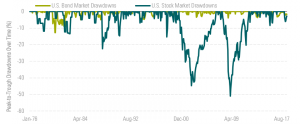
There are at least two good reasons to keep bonds in your portfolio, in our view. First, bonds historically haven’t given up nearly as much ground as stocks have during their worst respective drawdown environments. In other words, owning bonds when valuations are stretched is likely to be less detrimental to total portfolio returns compared with owning stocks at high valuations.
Exhibit 1 Bond Drawdowns [%] Aren’t as Scary as Stock Crashes
Source: Morningstar Investment Management calculation, Morningstar DirectTM data as of 30 June 2018.
Moreover, as shown below, because bonds tend to hold their ground (or even rise) when stock markets crash, they can also offer important ballast to multi-asset portfolios holding stocks in uncertain and volatile times. In today’s markets, when we’d argue a large portion of the equity market is overvalued, we like the diversification features and potential buffer that high-quality bonds can offer when equities sell off, even though our return expectations for Treasuries are relatively low.
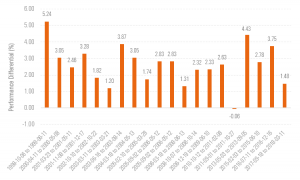
But it’s not just about staying invested in bonds—it’s also about picking the right bonds to invest in. Some fixed-income asset classes have fared better than others in rising rate environments. For the next two graphs, we look at 19 rising-rate periods since 1998 to compare performance of different fixed-income asset classes. First, we see that short-term bonds, which carry less duration (or interest-rate sensitivity), tend to outperform the broad bond market. Overweighting short-term bonds can offer the potential to minimize losses should rates move meaningfully higher, while continuing to provide capital preservation properties that high-quality bonds tend to offer during volatile market conditions.
Exhibit 2 Short-Term Bonds Tend to Outperform the Broad Bond Market [Percentage Points] in Rising-Rate Periods
Past performance does not necessarily indicate a financial product’s future performance.
Source: Morningstar Investment Management calculation, Morningstar DirectTM data as of 30 June 2018. Outperformance measured as difference between U.S. Aggregate 1-3 Year Issuance (“short-term bonds”) and U.S. Aggregate Bonds (“the broad bond market”).
Additionally, there are other fixed-income asset classes we can introduce to a multi-asset portfolio to mitigate its overall interest-rate sensitivity. We find that local-currency emerging-markets debt, which generally displays less sensitivity to developed market rates and lacks direct ties to U.S. monetary policy, has offered investors a considerable yield difference in the past over bonds issued by the U.S. government, as well as a diversified pattern of rate movement over time. While introducing other risks that must be evaluated, when trading at relatively attractive valuations, local-currency emerging-markets debt can help shield a portfolio during a period of rising U.S. interest rates.
Rising Rates Can Ultimately be Good for Long-Term Investors
It’s important to remember that rising rates means borrowers will pay investors more to hold their capital. As rates move higher, short-term debt rolls over to higher rates and investors can ultimately get paid more—but only if they stay invested.
At Morningstar Investment Management, we seek to manage interest rate risks in our portfolios while preserving return potential. The larger issue may be a behavioral one — as it often is — it’s easy to fear rising rates and trade out of bonds. This would be a mistake in our opinion. The path to higher rates is anything but certain, and bonds can play an important role in most market environments.
As the old saying goes, time in the market is generally superior to timing the market. Yet, investors
tend to have a bad habit of buying winners too late and dumping losers too soon.
Staying the course does not necessarily mean sitting still. It means avoiding bad behaviour,
remembering your goal and ensuring you approach markets with discipline.
“Stay the course” is a nautical phrase that has been popularised by world leaders, primarily in the
context of battle, according to Wikipedia. According to Stewart Alsop’s 1973 memoirs of a conversation
with Winston Churchill, the British prime minister contemplated towards the end of World War II:
“America, it is a great and strong country, like a workhorse pulling the rest of the world out of despond
and despair. But will it stay the course?”1
We ask the same question today of investors, after what has been an emotive period for financial
markets. From trade wars to Brexit, North Korean tensions to Italian political turmoil, we’ve had plenty of
noise to deal with. So, what do we mean by “staying the course”? It is not always about sitting still
(even though this is often the easiest path to investing success), but rather, to focus on the goal that you
set in the first place and ensure your behaviour aligns with it.
Let’s face it, investors too often redirect their focus from the destination to the journey. Much like in
other walks of life, we can lose focus, making us susceptible to capitulation or giving up at the exact
moments when we require fortitude and resolve. That is, investors are hard-wired to be procyclical,
chasing the winners and selling out of the losers because of a yearning to make money work harder for
us. This is not just conceptual, we can see it directly in the fund flow numbers.
Therefore, it is vital that as investors we remain vigilantly aware of how animal spirits can drive irrational
decision-making, and that we adopt a reasoned framework for investing. Behavioural errors can wreak
havoc on long-term portfolio returns due to excessive and unjustified turnover.
A Step-by-Step Guide to Staying the Course
The best thing an investor can do when contemplating change is to reflect on their goals. Would the
investment change align with the original investment plan or strategy for reaching well-defined goals?
The key question to ask is whether anything has fundamentally changed since setting the original
strategy or whether it’s just that the client is disappointed with the progress towards goals.
If something has fundamentally changed, the next question to ask is whether you can clearly
identify what has changed. Write it down, then balance this by writing what it might mean if
you’re wrong. This should include any misjudgment risk as well as the added costs if you
decided to change investments. You will often find that the change you desire is not
necessarily going to increase the probability of reaching your goal/s.
If it has “just” disappointed you, but nothing has fundamentally changed, the likely best
option is to stay the course. By thinking probabilistically and remembering that investment
markets never move in straight lines, you may avoid the perils of trying to time the market.
Furthermore, you may benefit by doing the opposite to your intuition (given the evidence
against it) and teach yourself to be a contrarian.
How We Think about Staying the Course
As professional, multi-asset investors, we focus on the investment objective, always bearing in mind the
opportunity costs and risks. We also write down a balanced thesis that ensures we remove any emotion
from our decision-making.
In this sense, staying the course is not idle or passive, but rather about staying aware. Some investors
may look at a recent period of lean returns and, with a hindsight bias and the herd mentality at play, will
fear for the future. Many will further justify to themselves that reward for risk is simply not sufficient
and will consider a change in strategy. This thinking is usually well intentioned, but it is dangerous and
must be thought through with a long-term perspective.
Staying the Course vs. Timing the Market
Investing, like many things, often involves taking the thorns with the roses. Over dozens of years and
through all investment literature there is one golden thread–the evidence clearly favours time in the
market over timing the market.
This can be illustrated in various ways, but one of the most compelling is to simply reflect on the cost of
missing the best days in the market. We show this below, illustrating how an investor can hamper the
likelihood of reaching their goals by overzealously trying to time the market.
The future is unpredictable, and nowhere is this truer than in politics and macroeconomics.
While an escalating trade war is possible, the more likely outcome is compromise.
We don’t base investment decisions on the whims of the market or politicians, but rather on our
well researched long-term valuation views.
Investors are better served by ignoring the headlines and focusing on saving more to reach long term
financial goals.
With the Trump administration starting a purported trade war with China on July 5, questions have
grown into fears over how tariffs may affect the global economy. However, we offer a more nuanced
response to the question, posed in the title, which is on many investors’ minds today: We do think U.S.
stocks are overpriced now and believe selling overpriced assets is a good discipline. But selling should
not be driven by fears, macro events, and the like. In fact, over the long run, investors usually perform
better when they ignore these market tremors and stay focused on their financial goals.
A Nasty Trade War Is Possible, But How Likely?
Investors seem spooked by the recently announced tariffs and the possibility that all of this may lead to
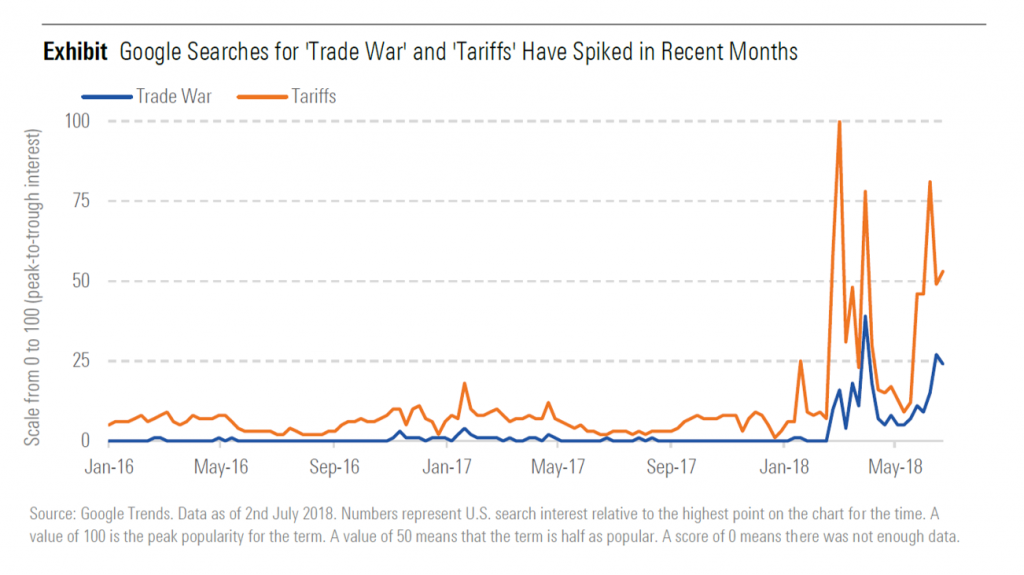
an ugly trade war. The subject has clearly grabbed attention and headlines. As illustrated in the exhibit
below, Google searches in the U.S. for “trade war” and “tariffs” spiked in recent months as the Trump
administration began an effort to renegotiate terms with its trade partners, starting with tariffs on steel
and aluminum announced in March. That move was aimed at China, but also impacted many other
countries.
Unsurprisingly, China prepared countermeasures by proposing tariffs on imports of American soybeans,
sending commodity prices tumbling. Mexico and Canada faced challenges as the U.S. administration
sought to renegotiate the North American Free Trade Agreement. European countries confronted the
U.S. over tariff threats on autos. Retaliatory measures from all sides raised the probability of an
extended conflict that may hamper global economic growth.
We don’t believe that the announced tariffs present a major threat to global economies. The proposed
tariffs are significant and would affect 23% of U.S. imports, primarily hitting auto imports. However, we
believe the U.S. economy, in particular, is large enough and domestically oriented enough to not feel too
much pain from current measures.
Of course, trade tensions and tariffs could become more severe and, at worst, tip the global economy
toward a recession. But getting too focused on a worst-case scenario ignores the possibility that
tensions cool, compromise is reached, and investors go back to focusing on strong earnings. It wasn’t
too long ago that presumed nuclear conflict on the Korean peninsula sent tremors through global
markets, but that seems to have been laid to rest for now.
Should Investors React?
The short answer: no. We focus on long-term valuations—the true and durable value of an asset class,
rather than its market price. Having a long-term perspective makes the next turn in the trade spat less
concerning to us. Instead, we ask, “How might this affect fundamentals over the next several years?”
Investors who trade on emotion and market reactions are more likely to sell when markets are low and
buy when they’re high. We seek to do the opposite, in part by sticking to our principled approach to
investing, which is designed to keep us rational in a sometimes irrational world.
Because we’re defensive now, we are prepared to be buyers if this or other concerns provide an
attractive buying opportunity. That point isn’t here yet. The effects of trade-war fears on U.S. stocks
have been minimal to date, with the post-crisis rally still up 15.3% on average for each of the last eight
years.
This long bull run has made U.S. stocks pricey, we believe, so we’re expecting below-average returns
from U.S. stocks over the next five to 10 years. But that does not mean we would ever sell stocks—or
any asset—based solely on newspaper headlines, the macro view, or fears. In fact, if anything, fearbased
price declines alert us to possible buying opportunities.
What Should Investors Do About Macro Events?
Perhaps the easiest thing to do is to do nothing. Ignore the headlines and stay focused on the long term.
But really the best investment advice is saving advice: develop a plan to reach your financial goals, then
stick to it. When you get an itch to do something different, try saving more—that’s probably the best
move to improve the chances of an investor reaching their goals.
Receive investment insights straight to your inbox:
By clicking subscribe, you agree to receiving editorial, events, product update and marketing emails from Morningstar and its related parties, until such time that you choose to unsubscribe or update your preferences via the link in the footer of our emails. You also agree to the Morningstar’s Terms, Privacy Policy and Financial Services Guide (AU).