At Morningstar Investment Management, we talk a lot about what’s knowable and unknowable, important and unimportant. Right now, COVID-19 and its effects on global markets are superlatively important and unknowable. We could spend a lot of time and effort attempting to forecast or predict what might happen. But, instead, we like to focus on what we do know – what is knowable.
While we don’t know when markets will regain their highs, when vaccines will be found or when the infection curve will have sufficiently flattened; we do know that over the long term, we’ll find that companies and consumers will behave similarly to how they have in the past.
The effects of volatility on recent portfolio performance
While we have experienced temporary losses, this is to be expected from time to time of any portfolio that invests in equities. Importantly, because of our portfolio positioning, these losses haven’t been crystallised – in fact, we’ve been able to add to our most favoured positions.
We’ve held strong in our view over the past few years that markets have been overvalued, with few compelling investment opportunities. In doing so, we held more cash leading into the downturn. As a result, our portfolios fell broadly less than other multi-asset portfolios and dramatically less than the Australian share market. We were able to do so by heeding Warren Buffett’s advice to be fearful when others are greedy – meaning we spent the last several years of the bull market acting cautiously and working to preserve investors’ capital.
Portfolio changes: A shift from capital preservation to return generation
The second part of Buffett’s advice highlights the need to be greedy when others are fearful. At our core, we’re value investors and this recent volatility has created buying opportunities for us, as we see valuations of certain assets becoming more attractive. Indeed, we’re finding assets that we consider to be good value for the first time in many years. Because of our continued focus on capital preservation, we have cash to deploy into these opportunities where the valuations make sense. While capital preservation remains a key part of our investment process, market conditions have changed. In the past, expected returns were poor and the risk of losing money was elevated. We now believe the risk of permanently losing capital is reduced, while the opportunity to invest and position for future returns is, in many cases, more compelling.
The sectors and investments where we see value – those that we believe are appropriately priced – remain much the same as they did prior to this bout of coronavirus-related volatility. We’re still seeing opportunities in the UK, Europe and some emerging market equities, and we believe that US equities are still generally expensive. However, there are sectors within the US equity market that, due to selloffs, have become more attractive, such as US financials and energy.
We’ve increased our equity exposure and reduced cash and defensive assets such as government bonds.
Talking points: what should you communicate to clients?
Understandably, clients are anxious. Here are the main points to address.
Value investing shouldn’t be confused with conservative investing. We’re not conservative investors who are always going to hold lots of cash. When things look expensive, like they have for the past few years, we’ll hold lots of cash to buffer the portfolios during volatile times. But the further markets fall, the more likely we will be to invest that cash in new opportunities. Should markets fall further, we’ll take advantage of the opportunities that arise.
We have increased exposure to equities. As value investors, the recent volatility has created buying opportunities for us, as we see the valuations of certain out-of-favour assets becoming more attractively
We are not fully invested. While there are many opportunities out there, the calibration of our positions is important. We still have cash to use if we need to. Should markets fall further we’ll take advantage of the opportunities that arise.
We’re shifting from capital preservation to taking advantage of opportunities that we now see in the market. As more people become concerned and exit equities, pushing prices lower, we’ll do the opposite and embrace the opportunities they’re presenting.
This may result in a few more bumps. But we believe that being able to buy long-term investments at attractive prices will keep our investors on course to achieving their financial goals.
“It’s not that we like pessimism, it’s that we like the share prices that pessimism brings.” – Warren Buffett
FAQs: Emergency Interest Rate Cuts — Will They Work? Do They Matter?
Question: Why are central banks taking emergency measures by cutting interest rates?
The first and simplest step is to understand the mandate of central banks. Their remit is to ensure the market operates with economic and financial stability. They look at all available information, primarily focusing on keeping inflation in check and minimizing unemployment. Under this lens, during moments of market panic—like today—where economic and financial conditions are less stable, we should expect central banks to act.
Their main tool to fight against this instability is interest rates, where they can alleviate the pressures on households, companies, and even the government, by reducing rates. They can also get inventive, as they did in the Global Financial Crisis, by injecting additional stimulus into the financial system. Whether that is so-called “quantitative easing”, “helicopter money”, or otherwise—they are looking for levers that help promote economic and financial stability.
For example, the Federal Reserve has recently agreed to purchase another $700 billion worth of Treasury bonds and mortgage-backed securities. They also struck a deal with five other foreign central banks, the Bank of Canada, the Bank of England, the Bank of Japan, the European Central Bank and the Swiss National Bank, to lower their rates on currency swaps to keep the financial markets functioning normally.
Most recently, the Reserve Bank of Australia has cut rates to a record low of 0.25% and will start a program of what is known as quantitative easing, for the first time in Australia’s history, which involves buying government bonds. The aim is to keep a lid on borrowing costs and support the economy.
Whether central banks get it right is one thing, but how an investor ought to respond is quite another.
Question: Are these emergency measures a good or a bad thing for investors?
On balance, it is probably a positive for long-term investors, although it can be hard to see when in the eye of the storm. That is, people tend to get a bit anxious when authorities like the Federal Reserve recognize the challenges in the environment, but—all else being equal—investors should see it as a positive when central banks make it clear that they’re proactively addressing the situation. For instance, the rate cuts could be beneficial to the speed and magnitude of the recovery.
The other positive is the fact that this is coordinated with other central banks, although the situation is quite different from one country to the other and requires different sets of measures. It is a bold move, for sure, but they’re making it very clear that they will play their part to keep the economy and the markets functioning. Again, this doesn’t guarantee it will work, but it is certainly better than a disconnected or passive approach.
One last point on this—financial markets are complex. The short-term market moves are highly unpredictable. They will undoubtedly be influenced by central bank action, but fear and greed will play a more prominent role amid the uncertainty. It is the long term we care about though.
Question: What might the central banks know that we don’t?
Let’s face it, the central banks don’t have a crystal ball, just like investors don’t have a crystal ball. Central banks do have access to an abundance of timely and accurate information. They also have many smart minds to analyse this information. But they can’t know something that is unknowable.
There is little the central banks can do if the economic activity stops because people can’t work, travel, shop, go out, and so on. What they can do is to try and limit contagion or secondary effects by:
Keeping credit available to households and businesses, and
Keeping markets functioning by providing liquidity to all market participants, keeping borrowing costs low, and trying to limit market financial stress which tends to work in vicious cycles as we saw during the GFC of 2008/09.
Some of the measures introduced recently are targeted at key elements of well-functioning global financial markets (such as the currency swap lines). This could have a dramatic impact if liquidity dries up.
This relays back to our original point. If we focus on the mandate of central banks, we should not be surprised that they are looking to stimulate against a great unknown. That is their responsibility. Our responsibility as investors is quite different. We need to think much longer term. We are looking at all the cashflows we expect an investment to deliver over its lifetime, then ideally pay a cheap to fair price for those cashflows.
Question: Will the rate cuts factor into portfolio positioning?
At Morningstar Investment Management, we are looking for two things during these times: risk and opportunity. From a risk perspective, we are dealing with the same unknowable that central banks are. We can be quite confident that coronavirus will be a historical memory 10 years from now, but we have little idea of what might happen tomorrow or three months from now. This is why we diversify, keep costs low and seek underpriced assets.
That said, we must also seek opportunity. On this occasion, market participants are sceptical that interest rate cuts will help the situation and/or are becoming worried that the central banks have little stimulus left to provide. During these times we have an opportunity to do what others can’t or won’t—to see opportunity amid the madness.
What does that mean exactly? Well, at a minimum, we calmly seek to rebalance (an approach that phases the selling of bonds, which typically do well in times of uncertainty; in favour of buying unstocks); and with the material declines we have seen in some sharemarkets, we have been a willing buyer amid the chaos.
It is important to note that we won’t know where the “bottom of the market” is. We can’t and don’t need to know that. However, we can focus on valuations and help our clients in growing their long-term wealth by buying assets for less than they’re worth and not panicking when everyone else is. We’d also like to note that “the market” is the culmination of several underlying markets. We take a granular approach to investing and will continue to analyse over 200+ asset classes from around the world.
To close, we leave the final word to the great Warren Buffett, which should be placed on everyone’s fridge during times like today:
“Every decade or so, dark clouds will fill the economic skies, and they will briefly rain gold. When downpours of that sort occur, it’s imperative that we rush outdoors carrying washtubs, not teaspoons. And that we will do.”
Since its original publication, this piece may have been edited to reflect the regulatory requirements of regions outside of the country it was originally published in.
When unsettling events such as the coronavirus (COVID-19) outbreak and market volatility dominate the news, it’s natural for investors to question and second-guess their investment strategy. As hard as it is to do nothing, it will serve investors best not to flap about in disarray, focus on the facts and remain calm.
What is a ‘black swan’ event?
A ‘black swan’ is an unpredictable event that is beyond what is normally expected of a situation and has (potentially) severe consequences. Black swan events are characterized by their extreme rarity and their severe impact. In recent weeks the global economy has been faced with two black swan events – the ongoing coronavirus and the unexpected Russian assault on oil prices, sparking volatility in markets and anxiety in investors.
In our opinion, both these situations will resolve themselves in time. However, the big debate across the country, and the globe, is around the issue of the medium-term economic impact and where-to-from-here? The reality is that periods of short-term volatility are inevitable and shocks to sharemarkets are not unusual. Even so, these types of events create uncertainty and often leave investors with the urge to do something.
Focusing on valuations is key
It is too early to assess whether the coronavirus outbreak will have a long-lasting negative impact on the global economy, but we believe immediate evidence points to a short-term impact (assuming health officials are successful at containing the outbreak).
If the impact is short-term, price declines have created buying opportunities and some asset classes have emerged as attractive to us. Warren Buffett, chairman and CEO of Berkshire Hathaway, has recently said “you don’t buy or sell a business based on today’s headlines. If the market gives you a chance to buy something you like and you can buy it even cheaper, then it’s your good luck.”
Oil price wars adding fuel to the fire
The second black swan event (which was most prevalent in the markets on Monday 9 March 2020) was the surprise and significant fall in oil prices. The decline was mainly caused by the inability of the OPEC+ alliance/cartel to agree to cut production, following the global slow down brought about by the Coronavirus. Instead, two of the largest oil-producing countries (Russia and Saudi Arabia) increased output, which led to a complete oversupply of oil, resulting in the significant drop in the oil price.
In our opinion, the dramatic move in the oil price is a short-term occurrence and we foresee prices returning to a more normalised level once coronavirus pressures have declined and growth fears start to abate.
When is the right time to buy assets?
Anyone that proclaims they know the perfect time to buy is likely lying or has been very lucky.
Our approach is to focus on probabilities: we change our positioning according to how extreme an asset is priced. In other words, we may buy an asset if we find it is attractively priced; if its price falls, we may buy more because—all else equal—it would have grown more attractive. We buy when we are being rewarded for the risk of taking on that investment.
What portfolio changes have been made?
The current volatility has, once again, highlighted the importance of effective portfolio management, asset class diversification and pricing in risk to protect capital.
Heading into this period of volatility, we had been positioning our portfolios away from the most expensive asset classes and markets, favouring better priced investments and cash. However, since the market volatility began in late February, we have seen rapid and meaningful declines in Australian and global sharemarkets. We have seen indiscriminate selling, with all global equity sectors recording losses regardless of their underlying fundamentals. With these declines, we have taken the opportunity to increase the portfolios’ exposure to growth by adding to Australian and global sharemarkets, most notably global energy shares, which have seen dramatic price declines.
Considering taking flight?
There are always reasons not to invest, however, take a moment to reflect over the past 100 years. We’ve been through two world wars, over a dozen recessions, a financial crisis, and a Great Depression, to name a few. Put in this context, the coronavirus fears are likely to eventually pass. We have seen governments and central banks around the world responding to the coronavirus impacts on the economy through massive spending programs and lower interest rates.
While the consideration to move assets to cash is an understandable response to recession fears, we believe that investors should stay focused on their long-term financial goals and remain calm.
Over the past decade, we have seen a steady rise in global sharemarkets; most notably, we have seen the longest rise in U.S shares in history. It is important to remember that there are times when markets can and do fall, and that market declines are a normal part of the business cycle. While market weakness is uncomfortable, it is important to keep a focus on the long term, rather than be distracted by short term events.
We are closely monitoring markets and the portfolios to ensure that we take opportunities to buy good assets at cheaper prices.
Since its original publication, this piece may have been edited to reflect the regulatory requirements of regions outside of the country it was originally published in.
Question: What are your views on the market reaction to the coronavirus?
Make no mistake: The human toll of Covid-19 has already been unacceptably high and could worsen. As investors, however, our minds remain on what we believe is most important when investing—namely, balancing risk and reward and coaching ourselves and others to make good decisions.
Prior to the start of the coronavirus-related market turbulence, we had regarded sharemarkets, in general, as expensive and trading at extremes. Heading into this period of volatility, we had been positioning our portfolios away from the most expensive asset classes and markets, favouring better priced investments and cash.
While it is easy for investors to react to alarming headlines and panic when events such as this outbreak occur, we believe that taking a more measured approach is key. While there are many ways this virus can impact the assets in which we invest, it is important to separate permanent damage which will impact the long-term fair value of an asset from temporary damage which will be forgotten.
What we have seen is indiscriminate selling across all equity markets, with all global sectors losing value regardless of their underlying investment merits. As valuation-driven investors, this has created an opportunity for us to buy assets that are now cheaper than what they were at the start of the year, indeed, some markets have not been this cheap in years. While markets could remain volatile for some time, we believe that it’s important to look beyond short-term market events and instead be on the lookout to buy unloved assets that have attractive long-term expected returns.
Question: Since the start of the coronavirus, is your positioning helping or hurting us?
Since the volatility in markets began, the multi-asset portfolios have lost value, reflecting the large broad-based declines we have seen in sharemarkets and other assets. Generally, the portfolios have not fallen as much as markets have, which is little consolation when overall returns are still negative. We have observed that on days when sharemarkets have recorded losses, the portfolios have performed better than the market indices, that is, the portfolios have lost less value than the market indices. This is what we would expect and is entirely consistent with the way that we have been managing the portfolios, which is focused on reducing losses during periods when markets are falling and avoiding expensive assets.
While markets have declined on most days since the start of the volatility, there have been several days when markets have strengthened considerably, and on those days, the portfolios have tended to not keep up with sharemarket indices, owing mainly to investments in energy shares which have performed poorly owing to plunging oil prices. While the price action so far has been indiscriminate, we would expect our positions to perform well once the market begins to focus on fundamentals.
Importantly, our healthy levels of cash have provided a buffer as markets have declined and allowed us to actively buy in response to cheaper prices when others can’t or won’t.
Question: What would you say to people who are tempted to move fully to cash at this time?
We view market volatility as an investment opportunity. Warren Buffett always says that he likes his stocks the way he likes his socks: on sale. So, often market volatility means lower prices. It’s a funny thing that in the stock market or the share market, people actually want more of something when the price goes up, and less when the price goes down. We think that’s exactly the opposite of how you should think about it. So, generally when prices fall, it means you’re able to buy stocks or shares, fractional ownerships of companies, at better prices. We view it as a positive, not a negative. And so we prepare for the volatility by demanding good prices before we invest, and that allows us to have capital or cash available to take advantage of the market opportunity.
So, it’s really important during periods of market volatility that you don’t overreact, that you don’t sell out your investment at the bottom. That’s the worst thing that people can do. Our research shows that those that sell out at the bottom and then buy back in, say, a year later when they feel more comfortable, do much worse than those that stay invested. So, we’re here to provide resources to support you in keeping your clients calm and sticking to the plan you have in place for them. In the short term, markets are going to move around a lot, and it’s very important that you take a long-term approach to investing. Our view is that when we have periods of market volatility or where prices fall, it’s often a time where you should be adding more to your investments rather than taking them away.
Question: When is the right time to buy assets?
Anyone that proclaims they know the perfect time to buy is likely lying or has been very lucky.
Our approach is to focus on probabilities: we change our positioning according to how extreme an asset is priced. In other words, we may buy an asset if we find it’s attractively priced; if its price falls, we may buy more because—all else equal—it would have grown more attractive. We buy when we are being rewarded for the risk of taking on that investment.
Question: Have you made any portfolio changes yet?
The current volatility has, once again, highlighted the importance of effective portfolio management, asset class diversification and pricing in risk to protect capital.
Heading into this period of volatility, we had been positioning our portfolios away from the most expensive asset classes and markets, favouring better priced investments and cash. However, since the market volatility began in late February, we have seen rapid and meaningful declines in Australian and global sharemarkets. We have seen indiscriminate selling, with all global equity sectors recording losses regardless of their underlying fundamentals. With these declines, we’ve taken the opportunity to increase the portfolios’ exposure to growth by adding to Australian and global sharemarkets, most notably global energy shares, which have seen dramatic price declines.
Question: Where to from here?
It is impossible to attempt to predict how long or how severe the coronavirus episode will be. It is possible that investment markets will be volatile until we see a peak in the number of infections.
It is important to remember that we manage portfolios for the long-term. Instead of trying to predict or guess how this global coronavirus outbreak will unfold in the short term, we are focussed on valuations. As a valuation-driven investor, we invest when an asset is trading below what we think it’s worth. We avoid popular and expensive investments that tend to do well when markets are rising strongly. During periods when markets are declining, our valuation-driven approach should help to minimise losses in the portfolio and preserve capital for members. Preserving capital by avoiding losses is key to achieving long-term wealth goals.
Over the past decade, we have seen a steady rise in global sharemarkets; most notably, we have seen the longest rise in U.S shares in history. It is important to remember that there are times when markets can and do fall, and that market declines are a normal part of the business cycle. While market weakness is uncomfortable, it is important to keep a focus on the long term, rather than be distracted by short term events.
We are closely monitoring markets and the portfolios to ensure that we take opportunities to buy good assets at cheaper prices.
Since its original publication, this piece may have been edited to reflect the regulatory requirements of regions outside of the country it was originally published in.
Transcript: The importance of staying invested in volatile times
Don’t flee the market in a panic, but rather embrace the turmoil as an investment opportunity–you’ll be better off in the long run.
Daniel Needham: Market volatility is one of the most reliable things that you can predict. You don’t know what prices are going to do next month, next year. The one thing we know is that prices are going to move around, and what we see is that prices often move around more than fundamentals, more than the underlying cash flows. And that means at times, you’ll have these volatile periods where market prices will fall a lot, where stocks’ share prices will fall, and maybe even residential property prices will fall. And often people get scared. People feel the pain of losses more than they enjoy the pleasure of gains. One of the most important things is that you don’t overreact and sell stocks when they’re down or sell shares when they’re down. That’s the worst thing that people can do. We think that what you want to be able to do is be prepared for the periods of market volatility by buying assets that you think are worth more than the price that you’re paying for them.
At times, that means being willing to hold more cash. We view market volatility as an investment opportunity. Warren Buffett always says that he likes his stocks the way he likes his socks: on sale. So, often market volatility means lower prices. It’s a funny thing that in the stock market or the share market, people actually want more of something when the price goes up, and they want less of something when the price goes down. We think that’s exactly the opposite of how you should think about it. So, generally when prices fall, it means you’re able to buy stocks or shares, fractional ownerships of companies, at better prices. We view it as a positive, not a negative. And so we prepare for the volatility by demanding good prices before we invest, and that allows us to have capital or cash available to take advantage of the market opportunity.
So, it’s really important during periods of market volatility that you don’t overreact, that you don’t sell out your investment at the bottom. That’s the worst thing that people can do. Our research shows that those that sell out at the bottom and then buy back in, say a year later when they feel more comfortable, do much worse than those that stay invested. So, we think the most important thing is to actually not do anything and to talk to your financial advisor or your financial planner and really stick to the plan. That’s what the plan’s there for. In the short term, markets are going to move around a lot, and it’s very important that you take a long-term approach to investing. Our view is that when we have periods of market volatility or where prices fall, it’s often a time where you should be adding more to your investments rather than taking them away.
The Impact of Coronavirus for Investors Public health outbreaks and epidemics like the recent coronavirus can quickly scare investors and, eventually, affect economies and businesses. The recent coronavirus outbreak has shut down airports, halted trade, and led to the rapid construction of new hospitals in China. The effects of the outbreak may push China’s economy into a period of slower growth, with stocks trading lower as investors seek protection.
So, what does that mean for the portfolios we run?
Key Takeaways
At Morningstar Investment Management, we are watchful. We continually monitor over 250+ markets, looking at everything from fundamental risks to contrarian opportunities.
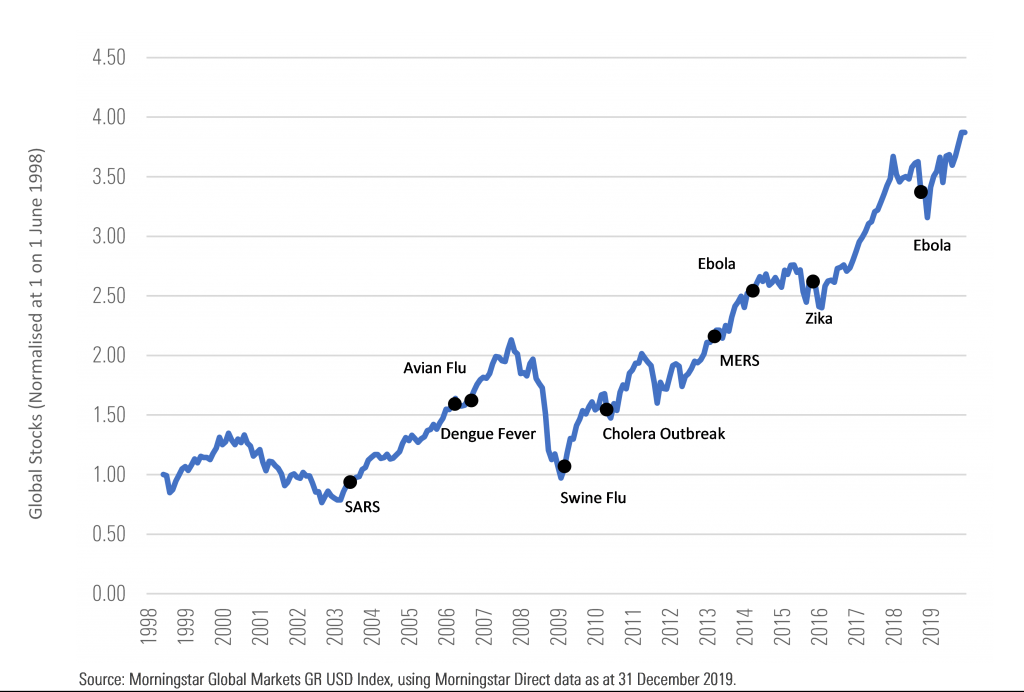
Looking at nine major outbreaks since 1998, there is little evidence linking global epidemics with long-term investment fundamentals.
The Chinese economy may slow, perhaps even meaningfully, but that is not a reason to invest or divest. Long-term investing is often best disconnected from short-term economic reactions, so we implore investors to maintain their focus on what matters.
Across the portfolios we run, we do have a relatively small exposure to Chinese assets (both directly and indirectly) but remain confident these holdings will deliver positive outcomes for long-term investors.
Epidemics and Investing To understand the potential impacts of an outbreak, we must make a forecast—formally or casually.
This is a complex task if done correctly, and outside the scope of this piece. But it’s important to acknowledge that we’re trying to peer into the future, which is wrought with intellectual danger.
No one can predict the future, but plenty of research suggest ways that forecasts can be improved.[1]
One way to improve the accuracy of a forecast is to start with base rates. How often do outbreaks become epidemics? What effect do epidemics have on economies or markets? For this latter question, we look to Exhibit 1 to provide a sense of base rates—market returns following major epidemics in recent history.
Exhibit 1 Investors Tend to React to Epidemics, But the Long-Term Picture is Positive
As depicted, market participants tend to react to such unforeseen outbreaks, but markets tend to recover by the six-month mark. This suggests that sentiment drives early losses, but sustained economic impacts are less than perhaps investors feared at the onset.
Another way to improve forecasts is through humility—especially knowing what you don’t and can’t know. Expert epidemiologists might be able to produce base rates on spread rates, mortality rates, and so on, but no one can predict how unknowable factors might affect the spread of this or any outbreak. That’s not to mention knowing how fear might affect markets.
So how can we make a reasonable assessment of the potential impact of the coronavirus? As long-term, valuation-driven, fundamentally based investors, our concern is any potential impact to businesses’ cash flows.[2]
For example, will the collective impact of the outbreak (fewer flights, less trade, loss of productivity, etc.) affect a few businesses, a few industries, or entire markets? That’s the question we’re asking.
Our answer is that, at this stage, we have to assume the outbreak will take a similar path to other recent epidemics, and thus we feel there’s no reason for investors to be alarmed. Note that there’s no “safe” approach for investors—for example, exiting stocks in favour of cash has its own risk, namely crystallising any losses suffered to sentiment while almost surely missing out on a rebound if the virus were to be contained quickly. So we want to proceed by assuming what we consider to be the most likely scenario, while taking other possible outcomes into account.
Ultimately, we are very watchful but aren’t taking any action. Our core ambition is to help investors reach their goals, which requires a measured and repeatable process to investing. Across our portfolio range, we may hold exposure to Chinese stocks, emerging-markets stocks, emerging-markets debt, and companies that sell into China to varying degrees depending on the portfolio mandate. Even so, we are still expecting that these holdings will deliver positive outcomes over the long term, and it would require a clear impact to fundamentals for our view to change.
Note that once the facts change, we would expect to change our minds. If we were to see a clear and significant potential impact to investment fundamentals, we would carefully study the situation, conduct rigorous scenario analysis, and try to incorporate the new information into our portfolios. Until then, we remain vigilant.
Final Thought With lives at stake, it would be uncaring to call the coronavirus “noise.” Yet, if we focus on the investor’s perspective, we believe it is not time to act. Moreover, we remain confident in our portfolio holdings because they reflect a solid base of research and resemble a well-reasoned way to invest. We certainly won’t be hitting the panic button and we hope you won’t either.
Nonetheless, while it remains very difficult to predict the impact that the coronavirus will ultimately have, it is worth highlighting that share and bond markets, in general, are overvalued. This means that the risk of losing money is elevated and markets remain vulnerable to any bad news, whatever the cause. In this regard, our portfolios remain defensively positioned, holding more cash than we otherwise might.
Further information If you have questions on discussions in this piece or want to propose a pressing question for our investment staff, please contact your financial adviser.
[1] See Superforecasting: The Art and Science of Prediction by Philip E. Tetlock and Dan Gardner. The Notes section cites numerous studies, including those done by Tetlock and his partner, Barbara Mellers.
[2] Note that as investors have a particular focus on fundamentals. As humans, we care deeply about the loss, suffering, and fear brought by this or any outbreak. But we mustn’t let our emotions drive investment decisions—now or in any circumstance.
For Recipients in Australia: This Report has been issued and distributed in Australia by Morningstar Investment Management Australia Ltd (ABN: 54 071 808 501; ASFL: 228986) which is regulated by the Australian Securities and Investments Commission. Morningstar Investment Management Australia Ltd is the provider of the general advice and takes responsibility for the production of this report. To the extent the Report contains general advice it has been prepared without reference to an investor’s objectives, financial situation or needs. Investors should consider the advice in light of these matters and, if applicable, the relevant Product Disclosure Statement before making any decision to invest. Refer to our Financial Services Guide (FSG) for more information at https://morningstarinvestments.com.au/fsg.
When We Buy Stocks… And Why (est. read time: 5 min)
“Whether we’re talking about socks or stocks, I like buying quality merchandise when it is marked down.” [1]
— Warren Buffett
Buy Low & Sell High, The Right Way
Let’s say you own a great business today and the price falls by 40% tomorrow. Should you buy more of it? All else being equal, you would be foolish not to buy more as long as your conviction in the intrinsic value of the business remains intact. Yet, the process of buying high-quality businesses at low prices is beset with behavioural challenges and something every investor must consider carefully.
Key Takeaways
For stock investors, every buying decision requires fresh perspective, regardless of whether the stock is trading near its low or high.
Investors need to be careful when buying stocks in certain situations. We believe structural change, rapid disruption, leverage, and poor capital allocation are all primary concerns.
Buying into weakness often makes sense, but it is not easy and can sometimes be the wrong thing to do.
In a portfolio context, we strive to adhere to a structured process to maximize the probability of making good decisions.
Identifying Risks When Buying Stocks
Some of the key risks to stock investors tend to cluster around the following situations:
Industries undergoing structural change. This can evolve via comprehendible means (an ageing population or industry in structural decline) or via rapid disruption that is harder to distinguish (wiped out via technological advancements).
The erosion of an individual company’s economic moat. A company without a durable competitive edge may benefit from a fad or it may temporarily benefit from a first-mover advantage, but will ultimately succumb to another company with a stronger competitive positioning.
Leveraged businesses that succumb to debt constraints. Prominently, if an investment falls in price, the debt can suffocate the capital, creating the conditions for a perfectly good business to be a value trap.
Businesses with poor capital allocation. For example, undertaking a monumental capital expenditure program when there isn’t the cashflow to support it, destroying the value of the business. Overpaying for an acquisition, especially without a strategic fit, or not reinvesting enough back into the business (research and development) could be other examples.
The other, which is likely to have relevance today, is when assets are still expensive. This may not fit the classic definition of a value trap, but an asset going from extremely expensive to moderately expensive is unlikely to make a good investment, even if the price has fallen meaningfully.
Lessons from a Classic Collapse
Some companies can appear strong on face value but tumble into structural decline. Take Kodak for example, where many investors in the 1990’s never anticipated the progression of digital cameras, nor that Kodak would be left behind in that progression. Buying in the dips would have been a terrible idea for most investors, as you would have continually bid up this exposure only to find it halve, halve and halve again.
Underpinning the above risks, a key challenge is that early and wrong can sometimes be indistinguishable in the initial stages of an investment. An investor who is early would likely prefer to increase their exposure as the probability of a turnaround increases (much like a poker player should). However, if that investment becomes wrong (a value trap), they should consider accepting their losses and moving on. It is entirely possible to be both early and wrong if the nature of the asset changes over time.
This is also a warning that cheap assets can get even cheaper, so it isn’t enough to simply buy cheap companies. We need to ensure the quality of their cashflows are sound and that they have durable advantages that allow for the benefits of compounding. For example, if a poor-quality investment falls by 20%, but could fall a further 30%, 40% or 50%, we likely want to avoid going all in.
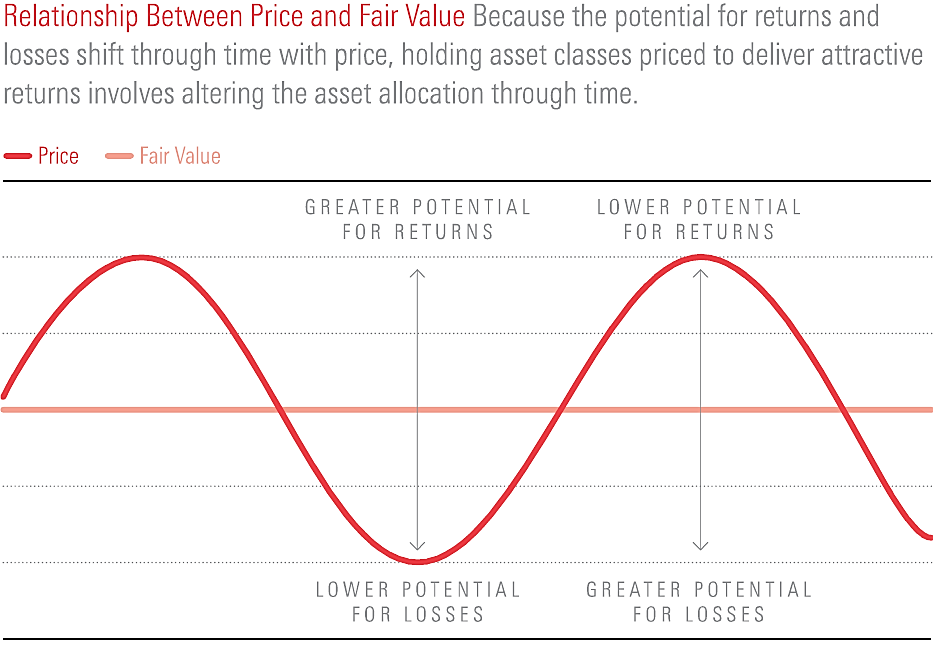
Exhibit 1 The relationship between price and fair value is the principle that guides valuation-driven investing. However, it does open potential issues regarding value traps.
Source: Morningstar Investment Management. For illustrative purposes only.
In principle, if we want to buy high-quality businesses at prices below their intrinsic value, we must conform to the idea that we might be early to the party. After all, you are likely buying the investment today because it is unloved and no one else wants it (yet). By undertaking this exercise, there are no guarantees someone will want it next week, month or even year. Hence the reason value investors often cherish the word ‘patience’.
Our Process When Buying Stocks
Beyond rigorous research and risk management, we face an undeniable truth: buying high-quality stocks at a discount is not easy and we’re very unlikely to get the perfect timing on an investment. If we do, it will require a lot of luck. However, this doesn’t mean we should ignore the opportunity as valuation-driven investors.
To bring this to life, we consider the following as an important checklist. The idea behind this structure is to reduce the likelihood and magnitude of any mistakes, while giving ourselves the best chance of capturing value for our clients and delivering strong long-term returns:
A Buying Checklist
Before executing on anything, ensure the thesis still stands. Never let behavioral traits like stubbornness, ignorance or fear sway an investment decision. This should apply no matter how uncomfortable it feels.
Review every stock in a consistent manner. We stick to four pillars; 1) identify the absolute return we might expect to achieve, 2) judge the return relative to the rest of the opportunity set, 3) examine the fundamental risks that could prove us wrong, and 4) assess the sentiment towards that stock (contrarian indicators).
Ensure the analysis includes a deep-dive on debt levels, capital allocation, and consider whether an industry is undergoing a period of structural change.
Have a clear portfolio construction mandate, and where appropriate, include limits on maximum exposure. This won’t always reduce the likelihood of errors, however we believe it will help reduce the magnitude of loss. We believe portfolios should be built for multiple outcomes, not just one.
Last, use a peer review process to vet investment decisions. This can be a constructive way to pick holes in a proposal and test the strength of the thesis.
In summary, we like buying into weakness, but only when it makes sense to do so. To our way of thinking, the only way to know if it makes sense is to conduct rigorous checks before every buying decision (such as the checklist above). The key is to leave emotions like fear or greed aside, instead focusing on delivering long-term returns that can help investors achieve their goals.
[1] Source: Berkshire Hathaway 2008 Shareholder letter
Why losing less is so important (est read time: 4 mins)
Compounding is an extremely effective investing tool, says Morningstar Investment Management’s Head of Institutional Portfolio Management and Solutions, Jody Fitzgerald, but it’s important to be aware of its inverse power on the downside.
The difficulties of investing in today’s market
Record low interest rates have created asset price bubbles across many investment markets around the world – in other words, the price you stand to pay for an asset or investment is greater than what it’s worth – also known as its fair value. Avoiding overpriced assets is key to reducing losses. At times like this, what you don’t invest in is as important as what you do invest in.
Identifying value for a smoother ride
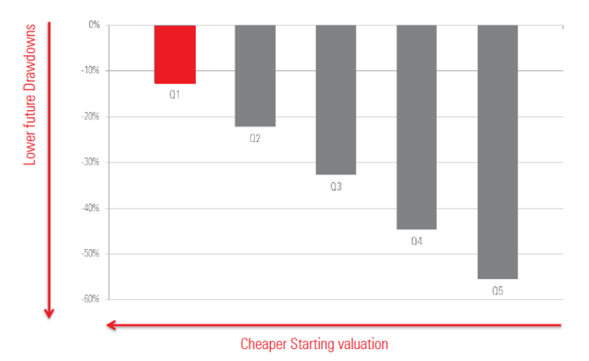
When we experience volatile and weak markets, overpriced assets tend to fall the furthest. And more broadly, assets reprice to reflect their true or fair value. A portfolio that’s avoided overvalued stocks can smooth the investor’s journey, enabling them to hold on to more of their money.
A case study: Negative compounding in practice.
Using a $100 investment and 10% interest rate as an example in Morningstar Investment Management’s video, Why Losing Less Is So Important, Fitzgerald acknowledges the passive returns afforded by compounding. “Compounding becomes more and more powerful the longer you’re invested, where effectively the interest that you earn continues to make more money for you.” That $100 becomes $110 after one year, or a $10 return. After another year, 10% delivers $11, without having to add any more capital to the investment.
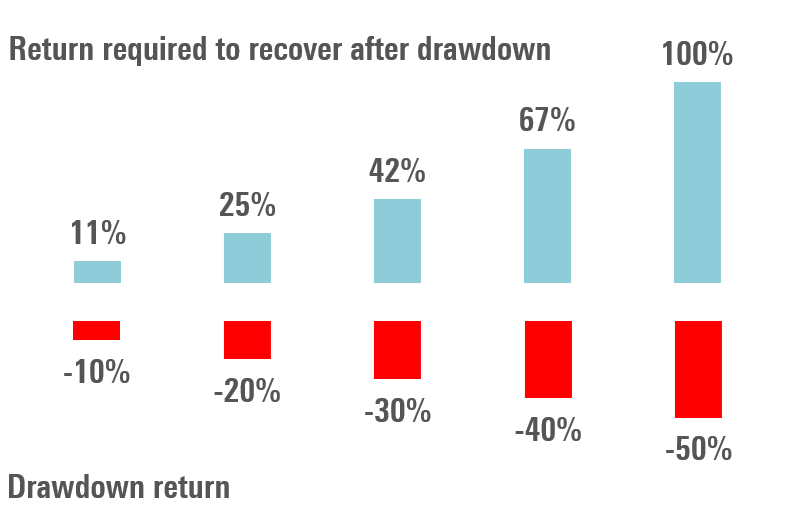
But this power becomes a real threat when compounding applies to losses, rather than gains. Assuming 50% of the initial $100 investment is lost, the investor then needs to regain that $50 – which is now a 100% return. “So, the more you lose in a down market, the more you have to make up in an up market, just to simply get back to square.” The challenge for investors is to preserve capital, setting themselves up for slower but sustained longer-term returns. When investment markets are consistently strengthening and regularly pushing to record highs, as we have seen in recent times, having patience for lower returns relative to the market indices, over the short term, is key.
Prevention is better than the cure
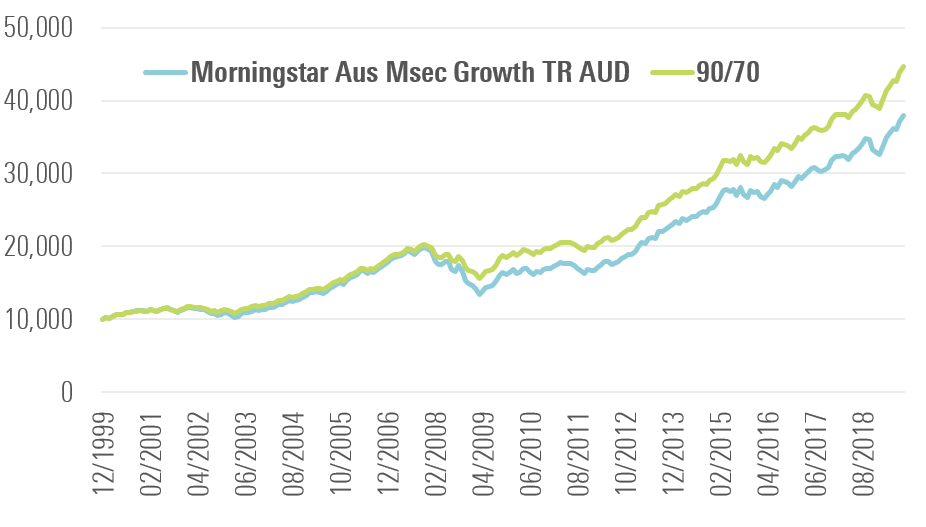
As explained by Fitzgerald in the video, losing less in a down market is crucial for building wealth over the long-term. Morningstar Investment Management has undertaken analysis that shows the benefit of losing less in falling markets. “We’ve simply assumed that if the average growth manager has a positive return, that we’ll only participate in 90% of that return. So, if they return 10%, we will only take 9% of that return. When they have a negative return, we’ll only participate in 70% of that negative return. So, again, if they produce a return of minus 10%, our return would be minus 7%.”
“You can definitely outperform the market in the long run by losing less in downturns. If you lose less in downturns, you’re starting from a higher base to compound off when the market start to strengthen”, Fitzgerald notes.
“You don’t need to fully keep pace with the market when it’s outperforming to do better, as long as you lose less the down markets.”
This Report has been issued and distributed in Australia by Morningstar Investment Management Australia Ltd (ABN: 54 071 808 501; ASFL: 228986) which is regulated by the Australian Securities and Investments Commission. Morningstar Investment Management Australia Ltd is the provider of the general advice and takes responsibility for the production of this report. To the extent the Report contains general advice it has been prepared without reference to an investor’s objectives, financial situation or needs. Investors should consider the advice in light of these matters and, if applicable, the relevant Product Disclosure Statement before making any decision to invest. Refer to our Financial Services Guide (FSG) for more information at https://morningstarinvestments.com.au/fsg.
How to prepare for a downturn (est read time: 4 mins)
Dan Kemp, Chief Investment Officer, EMEA
Ryan Murphy, Head of Decision Sciences, Americas
Key Takeaways
Market downturns are inevitable. Expect them, lean into them, embrace good habits. The good news is you don’t have to do anything different in a downturn than at any other period in investing. But if signs are pointing towards a downturn, it’s a great time to be reminded of good investing habits, including:
Looking beyond the immediate horizon. Having a long-term view is usually rewarded.
Embracing the chance to buy lower-priced assets.
Disabling electronic notifications of investment prices and portfolio returns. This will help you stay focused on your financial goals rather than the latest market noise.
Making regular contributions and setting up a plan to ‘save more later’.
“Far more money has been lost by investors preparing for corrections, or trying to anticipate corrections, than has been lost in corrections themselves.”
First, let’s consider what we mean by ‘downturn’. We’re talking about periodic sell-offs, often associated with uncertainty or negative surprises, with varying degrees of severity. Take, for example, the global financial crisis of 2007-09, one of the worst downturns in modern history, as well as the relatively minor 10% market reversals that happen every few years. Together, these losses mean that investors are likely to face multiple downturns in their lifetimes.
So, what steps can investors take to mitigate the emotional impact of a downturn?
Remember the cost of trying to time the market
Downturns can incite an urge to sell, leading investors to sit in cash for a while before getting back into stocks when it feels like the danger of further loss has passed. Not only is this a bad habit (market timing is notoriously difficult and is known to exacerbate the ‘investor gap’[1]), but it also carries a low probability of success. Cash rates can struggle to keep up with inflation over the long term, which means your efforts to preserve capital may erode your savings.
Action versus inaction: If you are investing for long-term wealth attainment, remember the probabilities support staying invested. Markets have a long history of rebounding, so you’re likely better off waiting patiently rather than trying to trade in and out of different investments. If you setup your investments some time ago, it’s worthwhile checking that everything is still appropriate for your goals, but generally our analysis has shown that ‘time in’ the market offers more reliable returns than ‘timing’ the market.
[2] The ‘investor gap’ is a measure of what investors actually receive (assessed using asset flow-adjusted returns) versus what they ought to have received if they simply bought and held.
Understand how loss aversion can drive good decisions
Losses heighten the desire to act, but it’s important to remember that the best things to do in the wake of a drawdown are much the same as at any other time. Building good saving habits is perhaps the most important step to take at any time. Investors should be saving regularly, especially towards their longest-term goals, such as retirement accounts, regardless of the stage in the market cycle. There’s also the ‘save more later’ technique, where you might commit (through an automated system or otherwise) to saving 3% of your salary one year, 4% the next year, 5% the year after, and so on. These small increases are an emotionless nudge that makes saving a habit.
Action versus inaction: The threat of losses can alter how investors perceive the value and relative effort of investing, including whether it’s worth pushing through the troughs to access the peaks. But this is where discipline can really help an investor: If it is a long-term goal, such as funding your retirement, stay the course and keep saving regularly. Investors who do this have an advantage—they are keeping their emotions at arm’s length, helping ‘bucket’ goals and disassociating market volatility from wealth attainment. This can act as a strong reminder of why investors should stay invested, while mitigating some of the concern that comes from periodic downturns.
Beware of technology traps
Though many fintech developments have made investing easier, some can add a layer of emotional stress. Receiving notifications every time trades are made, and money is gained or lost, can be a very effective way of tracking how a portfolio’s moving. But the constant pinging can foster anxiety around investments, potentially leading to panicked moves when markets sell off.
Action versus inaction: As Nobel Prize winner Richard Thaler said, “First, never underestimate the power of inertia. Second, that power can be harnessed.” This advice can be applied effectively here, nudging investors to check in on their portfolios less, resulting in fewer discoveries (and the subsequent emotional shock) of loss. Ideally, developing this habit early in a person’s investing career, or between periodic downturns where possible, should hold you in good stead when markets become tougher. Out of sight, (somewhat) out of mind.
Lean into the drags
Let’s face the facts—downturns can cause a significant drag on your wealth and your psychology. If an investment falls by 50%, it needs to rise by 100% to get back to the same level. Similarly, we feel losses approximately twice as much as we feel same-sized gains.
Techniques like diversification can offer a cushioning effect in both long-term recessions and shorter crashes. But rather than relying on diversification alone, we’ll refer you to one of our investment principles: that investment should be valuation-driven. Troughs in the market often lead to underpriced assets, which is where we (and some of the investing greats like Warren Buffett) believe that the best value is found. Rigorous fundamental analysis allows us to examine the full value of an asset, rather than simply its price, which some mistake for an indicator of quality. Thus, we see downturns as an opportunity to buy assets with strong fundamentals that can potentially deliver good long-term returns at lower entry prices.
Action versus inaction: Embrace the importance of being a willing buyer, not a pressured seller, after a market decline. Keeping a long-term view is key. While prices move constantly, most successful investments are built on patience as good quality companies often grow through recessions, but their true value is not appreciated until later. It’s for this reason that Morningstar Investment Management values patience and the ability to think independently as being the key characteristics of a successful investor.
Predictions hinder, not help
Last, we want to shed light on the recency bias—a common pitfall—which works on the assumption that because a trend or movement has happened in the recent past, it’ll continue into the future. This challenge may well be heightened during downturns, with long periods of lagging returns causing investors to second-guess their strategies.
Action versus inaction: If you find yourself focusing on recent returns, ensure you spend some time studying longer-term returns and periods of recovery. This search for dispelling evidence can help offset the gloom we tend to feel in a downturn. Remember, consistency is what matters. Buying and holding means you’ll experience both the best days and the worst days.
Since its original publication, this piece may have been edited to reflect the regulatory requirements of regions outside of the country it was originally published in.
This Report has been issued and distributed in Australia by Morningstar Investment Management Australia Ltd (ABN: 54 071 808 501; ASFL: 228986) which is regulated by the Australian Securities and Investments Commission. Morningstar Investment Management Australia Ltd is the provider of the general advice and takes responsibility for the production of this report. To the extent the Report contains general advice it has been prepared without reference to an investor’s objectives, financial situation or needs. Investors should consider the advice in light of these matters and, if applicable, the relevant Product Disclosure Statement before making any decision to invest. Refer to our Financial Services Guide (FSG) for more information at https://morningstarinvestments.com.au/fsg.
4 Key questions facing investors as we start 2020: Q&A
Question: What is your 2020 (to 2030) outlook?
Following the global financial crisis in 2008, interest rates sank across the developed world and stocks launched a 10-year bull-market run. Markets have cheered rising earnings and lower interest rates, but seemingly few people have paid attention to how long this accommodating landscape could last.
Put frankly, markets are out of balance. And we expect rebalancing to come in the next decade. Performance gaps today between value-style stocks and their growth counterparts and between U.S. and non-U.S. stocks have widened to historical extremes. Looking across history, economies and markets tend to be cyclical—trees don’t grow to the sky, as the German proverb puts it. So, we expect the next 10 years of returns to look very different to those of the last 10 years. Our view isn’t based on proverbs so much as market fundamentals.
The good news for our investors is that these rare extreme performance gaps have historically been followed by high relative returns for valuation-driven investing approaches. Whilst these periods of strong cyclical returns leave investors susceptible to performance chasing, they can bring the best long-term opportunities for contrarians. In this sense, we believe benchmarks are vulnerable to larger downside risk than normal, although we do see opportunities by investing in unloved markets and diversifying in a manner that protects against the risks ahead.
How will 2020 play out? That’s anybody’s guess. But we see opportunities for investors willing to be patient and stick to a valuation-driven approach.
Question: Why are “risk-adjusted returns” more important than just “returns”? People just care about the bottom line.
When we talk about risk-adjusted returns, we are focusing on delivering the maximum amount of return, for a given level of risk, as opposed to just generating returns without regard for the risk taken in achieving them.
This is an important distinction, because as humans, we like what’s easy and try to avoid what’s not. For investors, returns are easy, while risk isn’t. Risk analysis feels opaque, theoretical, and even counterproductive during the good times. When returns are rolling in, it’s easy to ignore risk, then a crash happens and it feels as important and alive as ever.
The lesson is simple: ignore risk at your peril. But we’d add to that—you need to focus on the right types of risks. We can usually bundle this into two core forms; 1) downside risks to your portfolio, or a permanent loss you can’t make back, and 2) overtrading risks, including poor timing decisions that trigger a permanent loss (especially those that would otherwise be temporary). Things like leverage, valuations, or becoming technologically obsolete are true risks. On the other side, volatility feels like risk, but we’d argue it is less of a concern. For example, a market bobbing up and down is less risky than a market that carries unsustainable debt levels.
So, yes, risk-adjusted returns are important, as long as they are defined in the right way. We’d even say risk management can make you money, as reducing drawdowns in market falls can be as important (if not more so) than keeping up with the market as it rises. This is especially true when you consider things like sequence risk, which is important for retirees. If your investment collapses by 50% in year one (from a market crash), it takes more than a 100% return to get back even, as you will be drawing on the capital when the balance is low.
Don’t be fooled into thinking goal attainment is all about catching positive returns. Those that think this way are procyclical, which is a risky way to invest. Markets are unpredictable, and investors can only take what they give us. To reach financial goals, consider those things you can control.
Question: Can you explain why being diversified across a range of asset classes will help investors outperform?
Diversification is often called “the only free lunch in investing” because the theorists have shown it increases portfolio efficiency by improving risk-adjusted returns. That is, you can get more return potential for a given level of risk, or you get the same return potential with less risk if you diversify. Diversification definitely helps, however we believe its application needs clarification.
First, what is diversification? At its core, diversification means finding assets whose returns are less linked to those of other assets—that one asset zigs as another zags. Many are content for this to refer to past returns—that is, they look at how correlated the past returns of Asset A are to Asset B, and, the less they are correlated, the more diversified they are. But we believe that we can’t look only at past returns to determine diversification for the future—we also need to consider diversification of the underlying fundamentals. A simplistic example is if Asset A is the stock of a company, and B is its debt. On paper, these are completely different assets and therefore provide diversification. To us, the investment success or failure of these assets rest on the same fundamentals—the business success of the company—and thus do not provide fundamental diversification.
Second, what does it mean to outperform? In any given year, diversification will deliver (by definition) lower returns than those for the highest-performing single asset class or security. However, when we broaden performance as being over an entire market cycle, we believe a multi-asset portfolio will typically beat single asset classes, especially on a risk-adjusted basis. Diversification can power this outperformance by limiting losses in down markets, meaning it can “catch up and pass” the high-flying asset classes, like equities, despite underperforming in rising markets. The rub here is a human one—can you stay invested through good times and bad?
Question: If a manager trails the benchmark over three or five years, despite delivering positive returns, should we be worried?
The question here is really about measuring investment success. So, let’s start with a sanity check—people aren’t usually investing for the sky. More often than not, people aren’t motivated by beating a benchmark or their friends, but rather, reaching their goals. This immediately brings the use of benchmarking into question, where we cite a misalignment between benchmark design and goals-based planning.
The best benchmark is one that is forward-looking and aligned to your financial goals. In a perfect world, every investor deserves their own framework to benchmark success, with transparency, measurement, and perspective all to be embraced. The challenge, of course, is that a forward-looking assessment is incredibly difficult to quantify, and there is no such thing as the “one-size-fits-all” approach.
Benchmarking tools—such as those we use—are powerful, but you cannot unshackle the backward-looking nature of them. What matters to an investor is whether their investment might be expected to help them achieve longer-term gains into the future. This mismatch requires care and highlights an important point around process versus outcome. There are many moving parts, some of which you can control—risk taken, assets held, timeframe considered—and many others you can’t.
Specifically, it is entirely possible to have a strong process (or a good decision) with a bad outcome, just as it is possible to have a poor process with a strong outcome. However, more often than not, a strong process will prevail and result in strong outcomes and vice versa. This is a key reason why we stress that people make comparisons over a longer time horizon—it allows the strength of the process (or the combination of many decisions) to unveil itself.
To round this out and answer the question directly—three to five years is a decent progress check, however looking backwards is unlikely the answer. We wouldn’t be so worried, as long as the inputs (people, process, parent, costs) continue to stack up. Remember that you can’t reap the benefits of a manager’s strong past performance.
Since its original publication, this piece may have been edited to reflect the regulatory requirements of regions outside of the country it was originally published in.
This Report has been issued and distributed in Australia by Morningstar Investment Management Australia Ltd (ABN: 54 071 808 501; ASFL: 228986) which is regulated by the Australian Securities and Investments Commission. Morningstar Investment Management Australia Ltd is the provider of the general advice and takes responsibility for the production of this report. To the extent the Report contains general advice it has been prepared without reference to an investor’s objectives, financial situation or needs. Investors should consider the advice in light of these matters and, if applicable, the relevant Product Disclosure Statement before making any decision to invest. Refer to our Financial Services Guide (FSG) for more information at https://morningstarinvestments.com.au/fsg.
We’ve taken your most pressing questions to our in-house investment professionals to answer them.
Question: Could the current low bond yields justify the high equity prices? Is there further room for even higher equity prices over the next 1 to 3 years?
Of course, they may be justified—and may even go higher—however we’d need to distinguish between cyclical and structural developments. That is, the long-run equity value discount rate really depends on whether borrowing costs will stay low permanently, due to some structural development, or likely to revert higher as conditions return to normal. This can be broadly captured in three scenarios.
1. In the ‘permanently low rates’ scenario, higher equity prices could be validated. Corporates will enjoy cheaper funding, default risk may remain lower than historical norms, and a transfer of wealth could see investors move from low-yielding bonds or cash into higher-yielding stocks. 2. In the ‘mean reversion’ scenario, the long-run relationship between unemployment and inflation will eventually stabilise, with rates nudging higher over time. As a result, profit margins will also likely normalise, sending equity multiples back to historical norms. 3. In the ‘inflation shock’ scenario, we may see the extraordinary levels of monetary stimulus create an unexpected rise in the cost of living. This would cause central banks to increase interest rates, likely suddenly, with both bonds and equities hurt at the same time.
While we must be open to the full range of possibilities, the probable outcome is that conditions eventually normalise. On this point, we think its dangerous behaviour to extrapolate recent trends into forecasts, so are generally sceptical of those predicting low rates forever. As Mark Twain supposedly said, “History doesn’t repeat itself, but it often rhymes.”
Question: Will diversification strategies continue to work given the unprecedented markets today?
At Morningstar Investment Management, we take diversification seriously. However, we’re generally quite sceptical of those who rely on historical correlation assumptions and prefer to instead look at it under the lens of fundamental diversification. That means we’re looking for an asset allocation that stands up to different risk drivers, not just co-movement.
As a simple example, it can be dangerous to buy equity in a company and then buy a bond from the same company, thinking you’ve got stock/bond diversification. The co-movement may look like diversification, but this won’t be helpful when it matters (if the company goes bust). The same can be said for asset classes, where an investor should think carefully about the underlying risk drivers of their asset choices. This has never been more important than it is today.
This question also highlights the important balance between conviction and overdiversification. Some of the greatest asset managers—whether equity-only or multi-asset—use concentration effectively. They balance out downside risks, to ensure the probability of permanent loss is small, but otherwise hold their highest conviction assets. At the other end, overdiversification can sometimes be a poor choice, as additional trading costs eat away at returns without any commensurate benefits.
Question: You’ve held high cash levels for some time. Why do you think it’s appropriate to hold elevated cash levels right now?
First, to establish a few facts. We think more cautious investors, or those with a limited investment timeframe, can benefit by holding healthy cash levels at present. For adventurous investors with a longer timeframe, the role of cash is still valid, but the sizing will often look quite different to those of a cautious investor (typically smaller).
Turning to our thesis, we are reminded of Warren Buffett’s quote, “holding cash is uncomfortable, but not as uncomfortable as doing something stupid”. It is counter-cyclical behaviour. To put a finer point on it—with bond market prices at record highs (yields at or near record lows) and equity market prices also near record highs, we believe it is prudent to protect capital. We think about this holistically, reducing the risk of a permanent loss by: a) favouring cheaper assets with less room to fall, b) offsetting risk via uncorrelated assets, c) using cash as a store of certainty, and d) monitoring the stewardship of all underlying investmentvehicles held.
But cash is also a form of offence, offering liquid ammunition that can be deployed as opportunities present themselves. Say, for example, that inflation unexpectedly jumps, causing central banks to raise rates quickly—a scenario in which stocks and bonds would likely fall together. Those that hold cash are in a position of power. This is just one scenario where cash would help an investor, but it will also work in several other scenarios that involve interest rate normalisation, a liquidity crisis, or a sudden market panic.
Importantly, we must disclaim that holding cash is not an effective long-term wealth strategy. It tends to earn less than inflation, which erodes your net worth. So, yes, we’ll use it to improve investor outcomes, but wouldn’t recommend it as a long-term wealth creation or preservation plan.
Question: Is gold something you consider in portfolios? When interest rates are negative, doesn’t this eradicate any disadvantages against cash or bonds?
We currently don’t invest in gold in our multi-asset portfolios, apart from the portfolios we offer in India. In general, gold doesn’t offer any cashflows to value (or compound), thus we’d expect gold not to generate a real return that is significantly above 0% in the long run. It is too often traded speculatively, where the future price is dependent on what the next buyer thinks it’s worth. To be clear, a zero percent real return might not be far off some fixed-income markets in terms of current yields, but it doesn’t make it an attractive investment (we also note there is not a carry premium associated with investing in gold).
To acknowledge the role it can play, gold does have some risk-hedging properties and may outperform in a risk-off environment. However, our research indicates that long-duration bonds (especially highly-rated government bonds from developed market nations) are generally a better hedge than gold in a risk-off environment. In general, gold is likely to do best in a stagflation or dollar crisis-type scenario, although these are low probability events.
Therefore, while gold can be debated as part of a risk management or portfolio construction exercise, it is highly unlikely we’d have long-run allocations to gold.
The evidence is clear—many retirees fear running out of money.
Most retirees have a non-linear spending pattern, which follows a smile curve over the course of their retirement. This differs from the commonly-used retirement projections that use straight-line spending assumptions.
Achieving a successful retirement outcome is a personal experience, but beware of the behavioural pitfalls.
Having enough income in retirement is a universal desire, and the lack of certainty around how much is ‘enough’ can cause anxiety and negatively impact lifestyle. A study conducted by Allianz in 2010 titled, Reclaiming the Future: Challenging Retirement Income Perceptions, involving more than 3,200 American participants ranging in age from 44 to 75, sought to determine people’s preparedness for retirement.
A fear worse than death
Allianz found that 61% of people feared running out of money in retirement; in fact, more people feared running out of money than they feared death. Just think about how serious that is. Furthermore, 31% were not clear on what their expenses were likely to be in retirement, and 36% were not sure if their income would last. This uncertainty, while sobering, represents a huge opportunity for the financial advice industry. People clearly need a plan, guidance, and advice to navigate their way to a happy and fulfilling retirement.
A Milliman study found more than half of Australians restrict their spending through retirement, and many, possibly up to a third, live as if they are in poverty. This is not what successful retirement looks like. Milliman made some suggestions as to why retirees were restricting their spending to such an extent. They were:
Self-protecting against longevity risk
Wanting to leave a bequest
A conservative demographic that had lived through multiple recessions
A function of the immaturity of the retirement phase of the superannuation system, or
As an industry, we may have actually overestimated the cost of living during the middle period of retirement.
All are plausible. Reinforcing Milliman’s final point, Morningstar research has found that indeed retirees tend to spend less than previously thought. In fact, Morningstar’s head of retirement research, David Blanchett, has contributed to this part of the discussion via his piece “Exploring the Retirement Consumption Puzzle” published in 2014 in the Journal of Financial Planning.
What is the retirement consumption puzzle he refers to? His research found that in the U.S. retirees are spending less than the models predicted. Traditional consumption models are potentially too simplistic; they assume straight-line expenditure in retirement. As a result, pre-retirees may not need to accumulate as large a nest egg as initially thought. Whilst every individual journey is different, Blanchett’s research found that in retirement spending declines over time, but not forever.
After a period of declining expenditure, spending begins to increase again as the retiree ages, largely due to increased medical expenses. Blanchett suggests following his ’retirement smile’ pattern (the visual of graphing how spending falls and then rises again—it looks a bit like a smile) which would enable retirees to start their retirement with almost 15% less accumulated wealth. Current consumption assumptions may result in oversaving for retirement.
The retirement smile (or at least the lack of straight-line spending in the real world) is something financial advisers have no doubt seen and can attest to already. It is important to get the saving/income/consumption equation right as it affects both when you retire and your quality of life in retirement. People could be anchoring their spending expectations around a higher figure, and this could be causing people to live more frugally than they need to.
Major decisions made sub-optimally
Living longer is great but it means we need to fund our retirement for longer. Defined benefits are almost a relic of the past as most of us are now responsible for choosing our own path to retirement. Inevitably, that will mean at some point in time we will need to navigate our way through market volatility.
Herein lies the challenge, as we can seriously harm our investment portfolio by making rash decisions. For example, the strong preference to avoid losses can cause us to behave in predictably irrational ways. These ‘cognitive biases’ can cause us to make sub-optimal investment decisions that can have lasting ill effects.
Episodes of market volatility can be particularly dangerous to investors. History shows individuals tend to sell when markets are falling and buy when markets are rising. Buying high and selling low—and repeating the process—erodes wealth. It is classic loss-aversion behaviour and one of the reasons people fail to capture market returns.
This was reinforced by an annuity salesman who once said: “People think they will live forever until they buy an annuity, and then they think they might die tomorrow.” This is also a classic loss aversion behavioural response.
What can people do to ensure they have enough?
A good start is to seek advice. A good financial adviser can provide clarity around the saving-income-consumption equation and help answer important questions such as: Are my goals achievable? Am I on track? Will I have enough? How long will it take me to reach my goals? When can I retire?
As humans we make both rational and emotional decisions, and financial advisers can help coach clients through periods of volatility before they make a decision they may regret. The average investor that works with a financial adviser can be significantly better off than those who go it alone. In the U.S., Morningstar has attempted to quantify the value financial advice brings in a white paper, Alpha, Beta and now…Gamma, and states that the value could be as much as 29% more income in retirement.
Each person’s journey is unique, and it was Benjamin Graham who said:
“Investing isn’t about beating others at their game. It’s about controlling yourself at your own game.”
With the right guidance, retirees who are restricting their spending might discover they have enough and perhaps they can live a retirement free of the burden of financial worry. Now that would be a successful retirement outcome.
We’ve been receiving a lot of questions about trade wars from you. Our in-house investment professionals have answered them for you.
Question: How do you suggest an investor protect against the reigniting trade war?
Let us first say that protection is only one side of the coin. Of course, we want to protect against the downside, but we equally want to avoid speculating on unknowable matters or getting scared out of an investment. These are behavioural traps that feed the ‘buy high, sell low’ problems that regularly haunt investor returns. Portfolio construction needs to be broader than focusing on a single potential downside pressure.
A better way to think about building portfolios, we believe, is to ensure adequate diversification that aims to buffer against any external shocks, not just possible trade war repercussions. That is, our attention should be on getting the most out of drivers of long-term returns such as total payouts (dividends and buybacks), expected cashflow growth, and any overvaluation/undervaluation changes.
Last, one of the best sources of protection is to look at developments opportunistically. As investor fear typically drives bad decision-making, it can lead to oversold assets that now present compelling value and have less downside risk (ie less potential for loss). We’re always looking for buying opportunities, but especially during crises.
Question. Do you put any weight on the latest trade war talks?
We look at trade wars through the lens of how it shapes market sentiment and therefore price action. As valuation-driven investors, we seek to buy assets when they are out-of-favour and underpriced. We do this via a four-pillar framework, where we look at:
10-year expected returns in absolute terms;
expected returns relative to other assets;
fundamental risks; and
contrarian indicators.
Trade wars may have a subtle impact on the fundamental risk pillar, yet it is the price action of other investors that can cause a shift in the other three pillars.
For example, let’s say the U.S. and China relax the trade tariffs and come to some sort of truce (keep in mind we avoid predicting such an outcome), other investors may become overconfident and push stock prices higher. If this were to occur, our 10-year return expectations would be reduced and the contrarian indicators would turn negative—which all else being equal, could lead us to reconsider our conviction in an asset.
Question. We’re a bit nervous about a market downturn and how a contrarian approach will hold up. Can you provide any context that may give comfort?
Downturns are always concerning. However you have every reason to be confident in our valuation-driven approach during such periods. To provide context, we often first point investors to think carefully about what is knowable (versus unknowable) and important (versus unimportant). We are dealing with a lot of important unknowables when investing, hence why we focus on the power of true diversification.
Further, there is one important knowable that has a habit of showing itself during downturns. That is, the importance of valuations. As valuation-driven investors, we view market prices in the context of their underlying fundamentals. For example, stocks are shares in businesses that aim to produce cash flows for the benefit of shareholders over time. Fundamentals represent the asset class’s ability to produce these cash flows into the future. In this context, we can better appreciate when an investment may be cheap or expensive.
The evidence supporting our valuation-driven approach is compelling to us, where we can show the downside protection offered by preferring cheap markets over the long term. Evident in Chart 1 below, we can see that all assets tend to suffer drawdowns (even the cheapest quintile). However, the cheapest assets tend to hold up much better than the most expensive. This should hold us in good stead.
Chart 1: The evidence supporting a valuation-driven approach is powerful. We can’t always avoid losses altogether, but a preference for cheaper markets can reduce severity of drawdowns.
Source: Morningstar Investment Management calculation. Using Shiller data from 1891 to 2014. For illustrative purposes only.
Question: Where is the market headed more broadly? How much worse could it get given the trade war?
People ask us this question often. Of course, the answer is, “No one knows where markets are headed”. We all know this question doesn’t have a true answer, but that knowledge doesn’t seem to stop us from asking it.
We think asking this question can be dangerous—not so much in the asking but in the weight put on the reply. We prefer to focus on the long term and try to tune out the noise to help us do so. For example, we don’t have cable news running all day in our offices, nor do we hold a morning meeting, like many asset managers do, to review data that came in overnight.
However, we know that market prices can depart from fundamentals in the short term. So, we study asset class fundamentals and market prices as a way to improve the probability of better performance. This is valuation—comparing the quality of an asset, defined as the level and durability of its cash flows, with its price. When we see assets grow overpriced, we expect them to underperform in the future, and when we see assets become well underpriced, we expect them to eventually outperform. In the meantime, we try to wait patiently for our thesis to play out, always monitoring fundamentals.
Question: What do you think of Chinese banks and the rising debt levels? Could this be the catalyst for the next debt crisis?
We know that since the 2008 financial crisis, Chinese banks have grown their assets significantly by lending to local governments and households. This has particularly shaped emerging-markets financials, where the largest country exposure is unsurprisingly China, accounting for 29% of the index, with the next 42% spread reasonably evenly between India, Brazil, Taiwan, South Africa, and South Korea. Therefore, while emerging-markets financials are certainly not isolated to the China story, they are heavily influenced by it.
As long-term investors, we’re not in the business of predicting if or when a Chinese debt crisis may flare. However, we do know that as the government looks to tighten liquidity, banks face the prospect of holding more capital while potentially incurring higher bad-debt provisions. When considered holistically and over the long term, one should expect a negative impact on profits over time, requiring a degree of caution to be built into valuation metrics. Looked at this way, we don’t see much attraction in the emerging-markets financials sector given current pricing and the potential downside risk. We do still like parts of emerging markets, where valuations make the risk-adjusted returns appear worthwhile.
Question. At what point do you know when to buy? Do you suggest drip feeding or waiting for blood on the streets?
Importantly, we want to disclaim that we never know the exact time to buy. Nobody does. Based on our decades of research, the best we can do is adopt probabilistic thinking, where we increase our positioning depending on how extreme the asset is priced.
In a portfolio context, this means we’re very selective. We monitor our position sizes closely and increase exposure only when we have meaningful confidence that we can enhance the expected risk-adjusted outcomes. That aside, for the average investor, drip feeding is likely to be a very sensible strategy.
U.S. equities still look overpriced, which is a concern to us. They make up around 55% of the global stock universe, which we believe is likely too high for a multi-asset investor.
We believe the right weighting should take valuations into account, however the weighting must also align to the objective of the portfolio.
Among the many things to consider, positioning should take into account the opportunity set, any portfolio constraints, costs, risk management and diversification.
Dealing with an expensive market
It is useful to remember that the U.S. equity market has enjoyed a bull run that had lasted longer than nine and a half years. For nearly two of those past years, our investment team has cast a wary eye at the U.S. market, uncertain how long the good times might keep rolling. However, our growing voice on the overpriced nature of U.S. stocks may have led to misunderstanding about our views on this unique asset class. So, to address the issue, we’d like to take a step back and consider a broader question: What’s the right weighting to U.S. stocks?
Valuations drive our asset allocation decisions
Determining the right weighting to an asset like U.S. stocks comes in at least four stages: a) determining the right baseline or neutral weighting if conditions were “normal”, b) understanding the valuations for U.S. stocks, c) understanding the valuations of other asset classes, and d) thinking about risk management. Let’s take valuations first.
Our central theory of investing—shared by value investors through time and around the world—is that an investor raises the probability for a good outcome if the price paid for an investment is less than its intrinsic worth. That is, we base our asset allocation decisions mainly on valuation, or a comparison of an asset’s price to what we think it’s worth. Estimating a stock’s worth is difficult, though. We believe the market usually prices securities quite effectively and efficiently, but history has shown that periods of irrational decision making recur. These are the situations we want to take advantage of—to buy assets when they’re underpriced and sell before they get overpriced.
With that in mind, we turn to U.S. stocks. Cyclically-adjusted price/earnings ratio (CAPE10)—one measure of stock valuation—has risen much faster and higher for U.S stocks than the ratios for stocks in Europe and emerging markets. We believe there’s plenty of evidence supporting our view that U.S. stocks remain overpriced. Indeed, our valuation estimates have led us to underweight U.S. stocks in our portfolios, but depending on the objective of the portfolio, we haven’t abandoned them.
We haven’t abandoned U.S. stocks
This gets us back to the first phase of deciding the weight for an asset class. Put simply, what should the normal weight of U.S. stocks be in a portfolio? Traditionally, the asset management industry has answered this question based on Modern Portfolio Theory, which would have an individual’s portfolio reflect the “market portfolio,” or the makeup of all investable assets. This is commonly known as the capitalisation weighting—the more an asset is worth, the larger its share of your portfolio.
Market cap-weighting is one place to start
One downside of cap weighting, however, is that it is determined by stock prices. As already discussed, prices can depart from fundamentals—thus, investors’ preferences and biases can affect capitalisation. The result has been that economies with well-developed stock markets have attracted more capital, while those with developing markets have attracted less capital. This has been exacerbated by the fact that most cap-weighted global benchmarks count only the “free-float” or traded portions of markets (curbing global weightings to emerging markets like Russia and China).
The result can be significant discrepancies between the size of a country’s stock market and the size of its economy. For example, while U.S. stocks claim about 55% of the global universe, the U.S. economy composed just 24% of the 2017 global economy as measured by the World Bank[i]. The U.S. punches well above its weight in this regard, while China, for example, contributed 15% of 2017 global GDP but composed only about 3% of global indexes. The message is clear—developed markets are generally over-represented relative to their economies and emerging markets underrepresented.
So, what’s the right weighting?
We don’t believe that GDP data represents the best baseline for asset allocation, either. In our view, it is best to consider markets holistically, and the key inputs to this thinking is summarised as follows:
Opportunity: It makes sense to look at the entire opportunity set, rather than focus on a singular market. When appropriate, we’d prefer to add niche positions that enhance the reward for risk across a portfolio.
Portfolio constraints: If we are limited to open-ended funds, the portfolio may be shaped differently compared to a portfolio that has the flexibility to access nuanced opportunities (for example, via ETFs). That is, we may think the U.S. market is overpriced, but components within it may be far more reasonably priced (such as U.S. healthcare or consumer staples).
Costs: All else being equal, we should favour the lowest-cost investments. We must always consider the opportunity set on an after-cost basis, which gives major markets like U.S. stocks a subtle advantage.
Risk management:S. stocks have enjoyed a steady climb for nearly a decade. Even the recent volatility hasn’t brought valuation measures in line with historical norms. This tells us that future returns for U.S. stocks won’t likely be nearly as good as they’ve been since 2009. Therefore, downside risk remains and we must position to protect against a large drawdown.
Diversification: We seek a mix of fundamentally diversified assets as this tends to buffer losses and provide good risk-adjusted rewards for multi-asset investors. We must embrace what we don’t know, so holding expensive assets like U.S. equities may be appropriate, although we’d prefer to hold relatively less in these assets.
We eagerly—but patiently—await a time when U.S. equity prices appear more attractive to us. This has not yet happened, despite the recent falls. Until such time, we’ll continue to favour areas that are more likely to help us meet our objectives. However, evading U.S. stocks altogether can also be a mistake, depending on the objective, especially if can take more granular positions in a portfolio (for example, investing via U.S. healthcare or consumer staples). Ultimately, deciding on the right weighting for stocks is complex, depending on the objective we’re seeking to achieve.
Receive investment insights straight to your inbox:
By clicking subscribe, you agree to receiving editorial, events, product update and marketing emails from Morningstar and its related parties, until such time that you choose to unsubscribe or update your preferences via the link in the footer of our emails. You also agree to the Morningstar’s Terms, Privacy Policy and Financial Services Guide (AU).